฿95 billion buying out
Thailand's international school market grew from ฿85bn to ฿95bn in a year — in an economy growing at 1.8–1.9%, with a fertility rate of 0.86 for 2025. Fewer children, far more money.
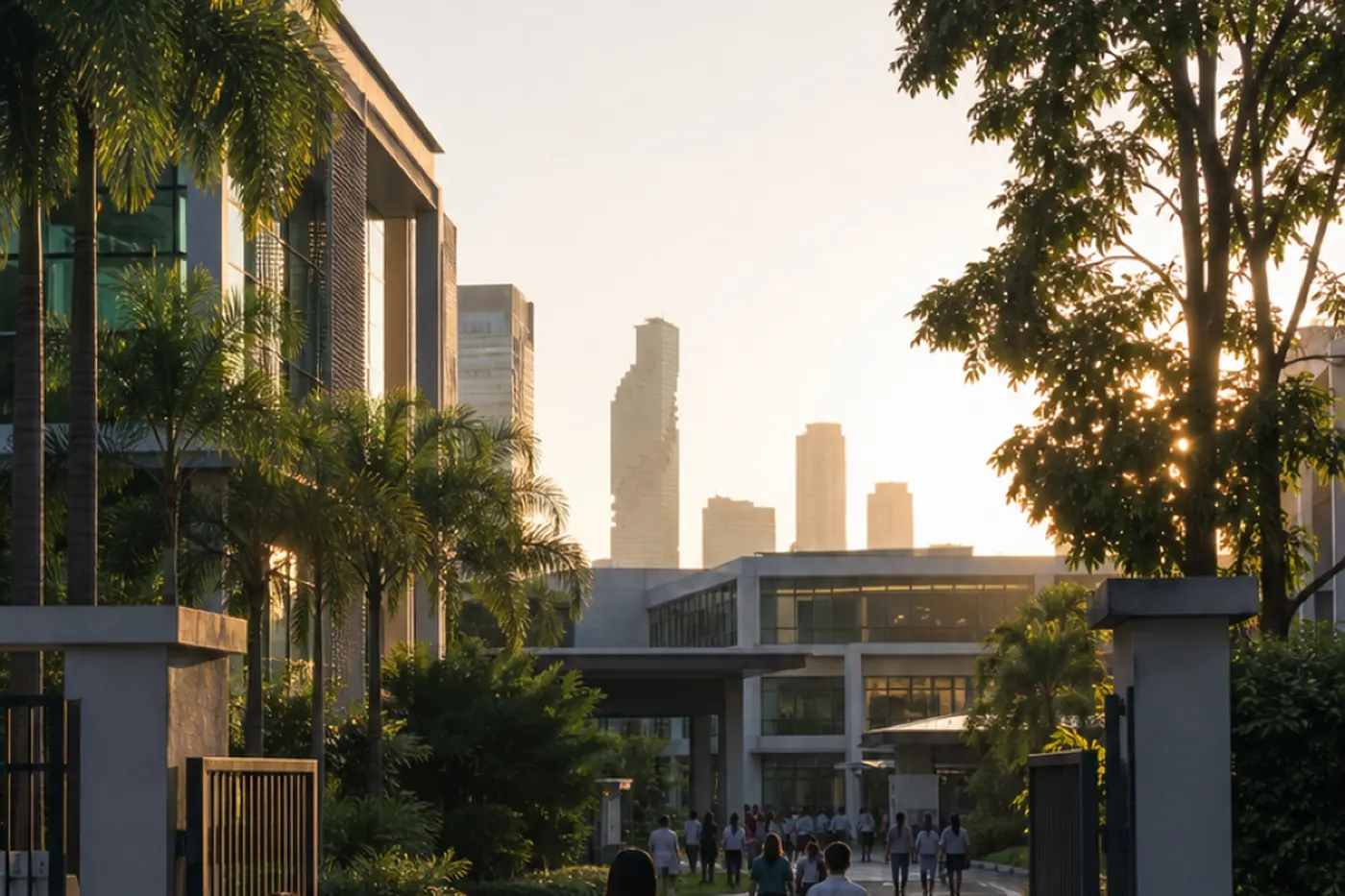
Thailand’s international school sector was forecast at ฿95 billion for 2025, up from over ฿85 billion the year before, by the Kasikorn Research Center.
Three things about that sentence that the earlier version of this article did not say, and all three matter.
It is a bank’s research estimate, not a national account. KResearch models a private sector’s revenue; nobody audits the total. It is the best figure available for this sector and it is not a measurement.
The 2025 number is a forecast, not an outturn. This article previously wrote “was worth ฿95 billion in 2025” in the past tense, as though it had been counted.
And the growth rate was wrong. The article derived 11.8% by dividing ฿95bn by ฿85bn. KResearch’s own published growth figure is 9.7% — because its 2024 base is “over ฿85 billion” rather than exactly ฿85 billion, and a rate computed from two rounded endpoints is not the rate the source published. Where a source gives its own rate, use it.
The comparison with GDP needs the same care, and previously had none. The sector figure is a 2025 forecast of nominal revenue; the 1.8–1.9% is a 2026 forecast of real GDP growth. Different years, and one is adjusted for inflation while the other is not. They should not be set against each other as though they were the same kind of number.
What survives, and it is still the point: a private education sector growing at high single digits while the wider economy grows at under two per cent. Thai business reporting describes it flatly as going up while the economy goes the other way, with private Thai schools closing at the same time.
Now add the number that makes it strange: Thailand’s fertility rate is 0.86, on Mahidol’s population institute’s estimate, and 2025 saw the fewest births in seventy-five years.
There are fewer children every year, and vastly more money being spent on educating them.
What it costs
At the top of the market, published annual tuition runs to roughly ฿800,000 to ฿1.2 million, depending on year group and campus.
The earlier version of this article gave a single figure of ฿1,156,500 and attributed it to one named school. That has been withdrawn, because the number could not be matched to a published fee line and because a single figure hides the thing that actually matters here.
Tuition is not the cost of attendance, and the gap is large. At Shrewsbury’s Riverside campus, published Year 13 tuition is ฿805,600 — for a two-term year, since the final year ends after examinations. On top of tuition a new pupil’s first year carries a ฿225,000 guaranteed place fee, which is non-refundable, and a ฿225,000 refundable deposit returned on graduation. Tuition covers lunch, textbooks and most after-school activities; it does not cover uniform, a personal device, music tuition, residential trips, examination entries or transport.
So “a year at the top school” is not one number. It is between roughly ฿800,000 and ฿1.2 million of tuition depending on where in the school a child sits, plus up to ฿450,000 of entry costs in year one, plus a tail of extras nobody publishes a total for.
Below that, a broad market. Schools at the lower end of international pricing run roughly ฿60,000–95,000 per term.
Some perspective from elsewhere on this site:
| Amount | |
|---|---|
| One year of tuition near the top of the market | ฿800,000–1,200,000 |
| State old age allowance, per year (article 38) | ฿7,200 |
| Street food vendor’s annual net income (article 13) | ~฿240,000 |
| A funeral (article 28) | ฿80,000–200,000 |
One year of tuition at the top of the market is between roughly 110 and 165 years of the state old age allowance, and three to five times what a street food vendor earns in a year.
I’m not putting those side by side to be inflammatory. I’m putting them side by side because they are simultaneously true, in the same city, and a publication that reported one without the other would be describing a different country.
Who’s actually buying
The instinctive assumption is expatriates. It’s wrong, or at least badly out of date.
Thai families are the growth market. The sector is not expanding at high single digits on the back of foreign postings — corporate expatriate packages have been shrinking for two decades. It’s expanding because Thai parents who can afford it are moving their children into it.
Meanwhile private Thai-curriculum schools are being squeezed from both sides: fewer children being born, and the families who can pay leaving for international schools. Thai reporting describes exactly this two-front pressure, with closures following.
That’s the story. Not a foreign sector growing, but a domestic exit.
What the market is voting on
Here I want to be careful, because it would be easy to slide into contempt for the Thai state system, and that isn’t a position I hold or one the evidence supports on its own.
What can be said accurately: parents with the means are choosing to pay very large sums to opt out, in growing numbers, during an economic slowdown, while having fewer children. That is a strong revealed preference and it’s worth taking seriously as data rather than as an insult.
What they’re buying is presumably some combination of English-medium instruction, international curricula and university pathways, smaller classes, and (I’d suggest, and article 39 It was never about hair is relevant here) a different relationship between institution and child than the one a generation of Thai parents experienced themselves.
Article 39 It was never about hair described a decade-long campaign that ended with a court ruling that school hair rules were an excessive violation of children’s bodily rights. Some meaningful share of ฿95 billion is parents deciding not to wait for that argument to work its way through every school in the country.
And the exit has a cost that isn’t on any invoice. Every family that leaves is a family with resources, influence and a strong interest in the state system, no longer inside it. Systems improve partly because people with options stay and complain. This is the money and the complaining leaving together.
The demographic squeeze underneath it
The fertility rate makes this stranger than it first appears.
Fewer children, more spending, means spend-per-child is rising faster than the market. A ฿95 billion sector serving a shrinking cohort is a much sharper concentration than a ฿95 billion sector serving a stable one.
Which follows directly from article 09’s argument: as families have one child instead of three, the resources available per child rise dramatically. Thailand is running the standard demographic transition (fewer children, each much more heavily invested in) and the international school sector is the most visible place it’s happening.
It also means the sector has a ceiling. You cannot grow a per-child market indefinitely against a declining number of children. At some point the arithmetic of one child per woman arrives here too — and enrolment already shows it: 77,734 pupils in international schools in 2024, against a peak of 87,343 in 2019, on the figures KResearch works from. The money is rising on a head count that has not recovered.
Common misconceptions
“International schools are for expats.” Thai families are the growth market.
“It’s a small luxury sector.” A forecast ฿95 billion for 2025 on Kasikorn Research Center’s estimate, growing at 9.7% while real GDP growth is forecast at 1.8–1.9% for 2026. Different years and different bases, but the gap is wide on any reading.
“Thai private schools are fine.” They’re being squeezed by falling birth rates and by losing paying families upward. Closures are happening.
“It proves the state system is failing.” It proves that families with the means are choosing to leave it. Those are related and not identical, and the distinction matters if you care about the state system.
“Fees are inflated by foreign demand.” Corporate expatriate packages have shrunk for years. Domestic demand is doing this.
Common questions
- How much are international school fees in Thailand?
- Published annual tuition near the top runs roughly ฿800,000 to ฿1.2 million depending on year group and campus — and tuition is not the cost of attendance: a first-year place can add a ฿225,000 non-refundable place fee and a ฿225,000 refundable deposit, before uniform, devices, exam entries and transport. Lower-tier international schools run roughly ฿60,000–95,000 per term.
- How big is the sector?
- Approximately ฿95 billion in 2025, up from ฿85 billion in 2024.
- Are international schools mainly for foreigners?
- No. Thai families are the primary growth market.
- Why are private Thai schools closing?
- A falling birth rate combined with families who can pay moving to international schools.
- Is the growth sustainable?
- It faces a demographic ceiling. A per-child market cannot expand indefinitely against a shrinking number of children.
- Are the quoted fees the full cost?
- Rarely. Application fees, deposits, transport, uniforms and activities are typically additional.