The fine has a ceiling and the damage does not
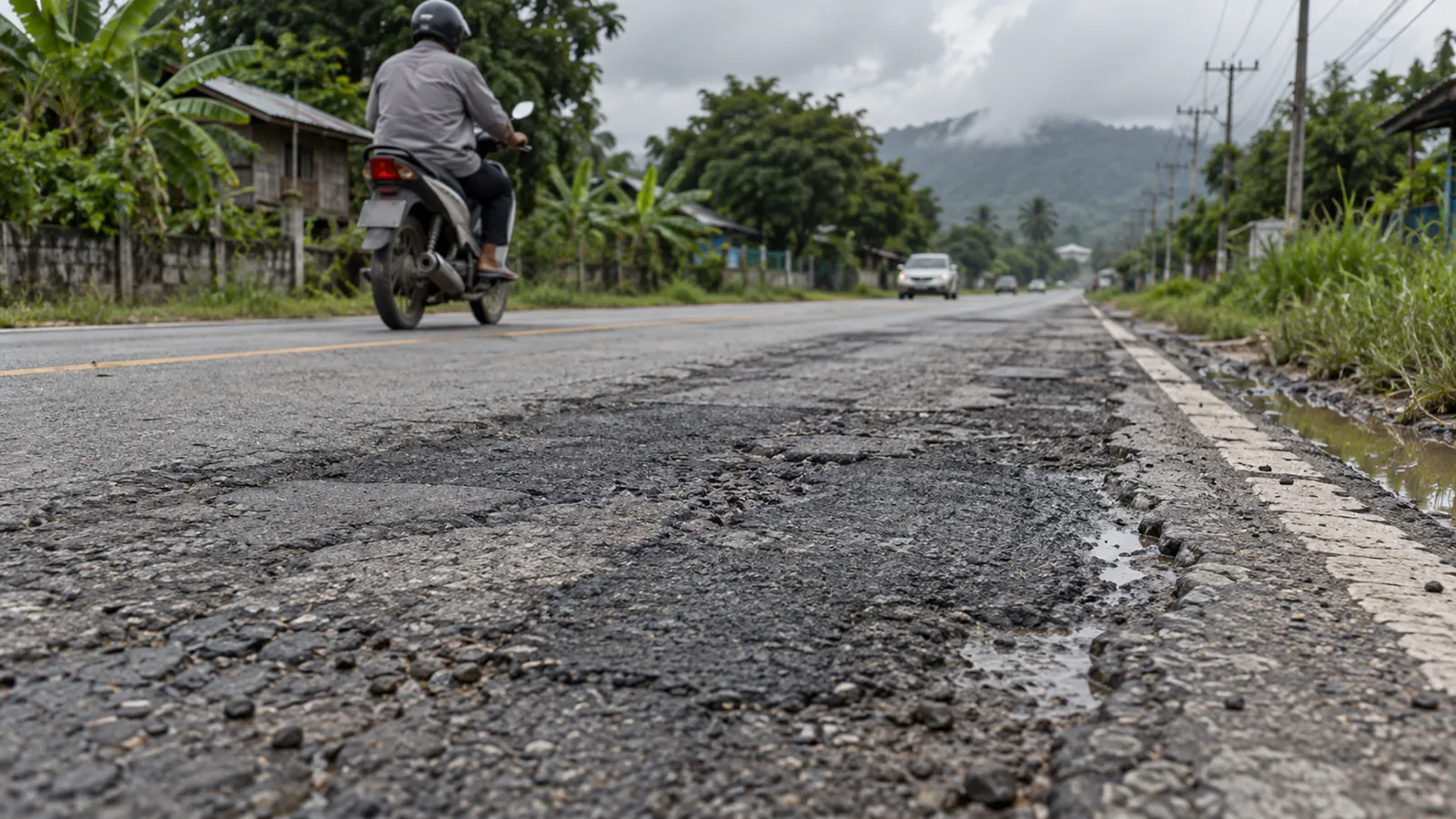
Road damage rises with roughly the fourth power of axle load. Freight revenue rises linearly. Thailand's penalty for overloading is a flat maximum — which means it binds least on the trucks doing the most damage.

In 1985 — Thailand’s anti-corruption commission put a set of measures on overweight trucks to the Cabinet.
It has been following up on them ever since.
The Commission’s own account, published in 2024, is admirably plain about the result: the recommendations were made, the follow-up continued, and overweight trucks remain a problem that has not been solved. In the intervening years it notes reports of officials neglecting their duties or acting corruptly, including the taking of ส่วย or bribes.
That is the state’s own anti-corruption body describing forty-one years of its own recommendations not working. Nothing in this article needs to allege anything, because the institution responsible has already published the diagnosis.
What has not been published anywhere is the arithmetic. That is what this article is for.
Why a small overload is not a small problem
Road damage does not rise in proportion to axle weight. It rises far faster.
The relationship comes from the AASHO Road Test, conducted in Illinois between 1958 and 1960 and formalised in the 1962 interim guide, which remains the basis of pavement design worldwide. It found that pavement damage is approximately proportional to the fourth power of axle load.
The consequence is not intuitive, and it is the whole subject.
Doubling an axle load does not double the damage. It multiplies it by about sixteen.
Work it through at ordinary Thai overload levels. Taking load as distributing across axles proportionally:
Twenty-five per cent over the limit does about 2.4 times the damage.
Fifty per cent over does about 5 times.
Twice the limit does about sixteen times.
A truck at 25% over is not a truck causing 25% more wear. It is a truck causing the wear of two and a half compliant trucks, on one trip.
Now put the operator’s side next to it
The operator’s gain from overloading is linear. Twenty-five per cent more cargo is roughly twenty-five per cent more freight revenue on the trip. Fifty per cent more cargo is fifty per cent more revenue. Fuel rises somewhat, so the true gain is a little below linear, but linear is the right shape.
So one side of this transaction grows as x. The other grows as x⁴.
Divide one by the other and you get the finding.
The public’s loss relative to the operator’s gain rises with the cube of the overload factor.
At 25% over, the damage is about twice the gain. At 50% over, it is about three and a half times. At double the legal weight, the public loses about eight times what the operator makes.
The gap is not a constant. It widens, sharply, with every extra tonne.
Which is why the penalty is built wrong
Section 73/2 of the Highways Act B.E. 2535 (1992) sets the penalty, and its wording matters:
Whoever breaches section 59 paragraph one, or an announcement of an officer appointed by the Director of Highways to control highways under section 61 paragraph three, shall be liable to imprisonment not exceeding six months, or a fine not exceeding ฿10,000, or both.
Two things follow from reading it rather than summarising it.
The weight limit is not in the Act. It is in an announcement made under section 61, which is why the figure moves without Parliament and why the offence is defined by reference to a document rather than to a number in the statute.
And the penalty attaches to the breach, not to its size. One ceiling, whatever the excess. In 2023 the Ministry of Transport proposed raising the maximum to ฿200,000.
That proposal has not become law. As of September 2026 every current Thai guide to the truck-weight rules, including those written for the 2026 model year, still gives the section 73/2 figures — six months, ฿10,000, or both — and no amending Act has appeared in the Gazette; a proposal three years old is still a proposal. Anyone who needs the current figure at a later date should take it from the Act rather than from here — and the argument below does not depend on which number is right, because it is about the shape of a flat ceiling, not its height.
Both numbers are flat maxima, and that is the defect — not their size.
A ceiling on a penalty binds least on the offender doing the most damage. A truck 10% over and a truck 100% over face the same maximum, while the second causes roughly sixteen times the damage of a compliant vehicle and the first causes about 1.5 times.
So the cap functions as a limit on liability that is worth almost nothing to a marginal offender and worth a great deal to an extreme one.
Raising the maximum from ฿10,000 to ฿200,000 changes the level and leaves the shape. It would make the deterrent real at the bottom of the range and would still be flat across the top, which is precisely where the fourth power lives.
A penalty that matched the damage would scale with roughly the fourth power of the overload, and it would have no cap. Whether that is politically achievable is a separate question. What can be said is that no flat figure, however large, is the right instrument for a quartic harm.
And behind all of it, the thing you cannot see
Here is the property that makes this the hardest enforcement problem in Thai road law, and this site has now arrived at it eleven times from eleven directions.
A rule binds where the behaviour it governs is observable by another person.
Axle weight is invisible. A loaded truck at the legal limit and a loaded truck at double it look the same from the roadside. The fact that determines whether an offence is being committed exists inside the vehicle, as a number, and cannot be established by looking.
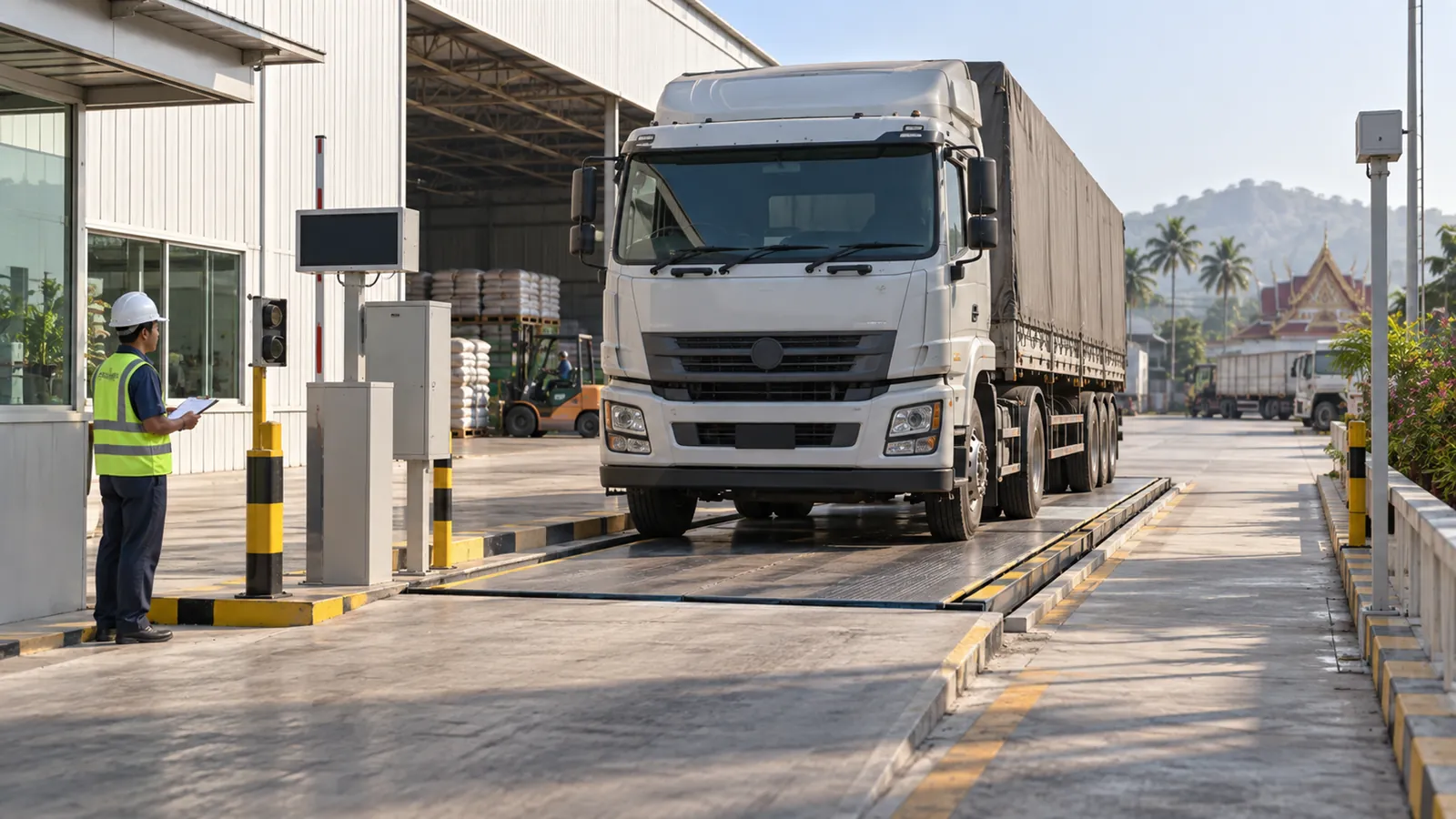
It can only be established at a weighbridge — a fixed installation, at a known location, which a vehicle may route around, and which is operated by a person exercising discretion.
Compare this to article 156’s finding on red plates and article 161’s on entertainment venues. In each case a rule is written around a fact that an inspector cannot verify at a glance, and in each case what actually gets enforced is whatever happens to be visible.
The remarkable thing about the NACC’s remedy
Read the Commission’s six recommendations, adopted by Cabinet resolution on 28 December 2021, and notice what two of them are actually doing.
The Cabinet assigned the Ministry of Transport as lead, working with Agriculture and Cooperatives, Commerce, Interior, Industry and the Royal Thai Police. The recommendations were: enforce the law against operators as well as drivers, using the Criminal Code’s instigation provision; agree a memorandum of understanding across the agencies responsible for different roads; convene the agencies on enforcement; introduce origin weight tickets; push automatic weighing technology; and strengthen supervision of officials in units where problems have been reported.
The fourth recommendation is that trucks should carry a weight ticket issued at origin from a scale certified by the Central Bureau of Weights and Measures — and should display a sign showing the actual load weight while moving.
Read that again. The proposal is to write the weight on the outside of the truck.
The fifth recommendation is to deploy high-speed weigh-in-motion and bridge weigh-in-motion sensors — and the Commission states the purpose explicitly: to reduce interaction with, and the exercise of discretion by, officials in the weighing process.
Two recommendations, one mechanism. One makes the weight visible to anyone on the road. The other makes it visible to a machine that has no discretion to exercise. Both convert an unobservable fact into an observable one, and the Commission’s fifth recommendation says in its own words that the point is to remove the human from the measurement.
This site has spent eleven articles arguing that Thai rules fail where the governed behaviour cannot be seen. Here the state’s own anti-corruption commission has reached the same conclusion and written it into a Cabinet resolution.
It was adopted in December 2021. The Commission published its follow-up in March 2024 reporting the problem unsolved.
What the people at the weighbridge say
The NACC’s article includes something unusual: the operational view from a station.
The head of the Udon Thani inbound weight inspection station, Mr Ritthirong Kaewpatcha, described the conditions his unit works under. Insufficient staff. Legal provisions on the powers of field officers that are still not clear. Physical risk to officers doing the work. And budget that is both late and inadequate.
That is worth sitting with. The recommendations concern discretion at the weighbridge; the person at the weighbridge reports being understaffed, unclear about his own authority, in personal danger, and underfunded.
Those two accounts are not in conflict. They are the same finding from opposite ends. A measurement point staffed by too few people with unclear powers and no money is a measurement point where discretion is unavoidable, whatever anybody intends.
What it costs
The Department of Highways is reported to allocate in the order of ฿26,000 million a year to road maintenance and repair. That figure was not verified against a departmental budget document and is carried as reported.
⚠️ That figure is from a search summary of a parliamentary page and has not been verified against a Department of Highways budget document. It must be before publication.
No published Thai figure was found apportioning that budget between ordinary wear and overloading. The NACC states that overweight trucks cause damage to roads and bridges resulting in significant annual losses to the maintenance budget. It does not put a number on it, and neither will this article.
The gap matters, and it is worth naming. The whole case for enforcement rests on a quantity that appears to be unmeasured. Given the fourth-power relationship, even a modest proportion of overloaded vehicles would account for a large share of the damage — which is exactly the calculation nobody appears to have published.
Common misconceptions
“A bit over the limit is a bit more wear.” Damage rises with roughly the fourth power of axle load. Twenty-five per cent over is about 2.4 times the damage.
“The fines are too low.” They are, but that is the smaller problem. They are flat, and the damage is not.
“Nobody has looked at this.” The anti-corruption commission first put measures to Cabinet in 1985 and has followed them up for forty-one years.
“It needs new technology.” The technology is in the 2021 Cabinet resolution. Weigh-in-motion sensors are ordinary equipment internationally.
“It’s a police problem.” The Cabinet resolution assigns six ministries and the national police force. The recommendations concern origin weighing, cross-agency agreements and automated measurement at least as much as enforcement.
Common questions
- How much damage does an overloaded truck do?
- Damage rises with roughly the fourth power of axle load. Twenty-five per cent over the limit is about 2.4 times the damage; double the limit is about sixteen times.
- Where does that relationship come from?
- The AASHO Road Test, Illinois, 1958–60. It underpins pavement design internationally, though the exact exponent is debated.
- What is the penalty in Thailand?
- The Road Act provides a maximum fine of ฿10,000, imprisonment up to six months, or both. A rise to ฿200,000 was proposed in 2023.
- Why doesn't raising the fine fix it?
- Because a flat maximum applies equally to a vehicle slightly over and one at double weight, while the damage differs by an order of magnitude.
- Why is it hard to enforce?
- Weight cannot be seen. It can only be measured, at a fixed installation, by an officer.
- What has been proposed?
- Six measures adopted by Cabinet in December 2021, including origin weight tickets, an external weight display on the vehicle, and automated weigh-in-motion sensors intended to remove official discretion from the measurement.
- How long has this been under consideration?
- Since 1985. Forty-one years.