A hundred per nationality: Thailand's permanent residence, explained
Thailand caps permanent residence at 100 people per nationality per year. For most nationalities the quota has never been the problem — almost nobody applies.

Thailand grants permanent residence to a maximum of 100 people of each nationality per year, plus 50 stateless applicants.
That figure gets quoted constantly, usually as evidence that Thai PR is effectively unobtainable. A hundred Britons a year, a hundred Americans, out of hundreds of thousands of foreign residents; it sounds like a lottery you shouldn’t bother entering.
Except that for most nationalities, the quota has never been reached.
Only two nationalities are reported as regularly approaching or exceeding it: Chinese and Indian. For most others, the number of people actually granted permanent residence each year is fewer than 100 — not because applications are refused down to a limit, but because fewer than 100 people apply.
So the famous barrier isn’t the barrier. If you’re British, German, Australian or American, you are not in a competition. You’re in a queue that is mostly empty, and the reason it’s empty is that the requirements filter people out long before the quota does.
That is a genuinely different picture from the one the number implies, and it’s the single most useful thing in this article.
What it actually requires
A qualifying visa history. A non-immigrant visa, with one-year extensions of stay for at least three consecutive years up to the day you apply — the Immigration Bureau’s own wording.
A qualifying category. Investment; working or business; humanitarian grounds — the spouse, parent or unmarried child under 20 of a Thai national or an existing permanent resident; expert; and a residual case-by-case category.
Income or investment. For the working route, a salary of at least ฿80,000 a month for the two years before you apply, or tax returns showing annual income of at least ฿100,000 for two consecutive years, plus at least a year in your current job. For the investment route, at least ฿10 million brought into Thailand and invested.
A Thai language interview. This is not a formality. The Bureau’s guidance says the interview “includes the test of the understanding of Thai language: speaking and listening”, and that missing the appointment without good reason is treated as withdrawing.
A points-based evaluation covering income, education, employment, Thai language ability, and other factors.
And patience. The window is set each year once the Interior Ministry’s quota notice is in the Gazette, and it moves: the round for 2025 was open from 9 March to 3 April 2026. The application fee is ฿7,600, non-refundable; on approval the residence permit costs ฿191,400, or ฿95,700 for the spouse or child of a Thai national or existing resident. While the application is pending you are given 180-day extensions of stay, and decisions typically take more than a year.
Where people actually fall out
Look at that list and the filtering becomes obvious.
The salary requirement removes most retirees, who are the largest single category of long-term foreign resident in Thailand. Someone living comfortably on a pension of ฿60,000 a month is outside the employment route regardless of how long they’ve been here.
The Thai language interview removes a great many long-term residents. It is entirely possible (common, in fact) to live here for fifteen years with functional survival Thai and be unable to hold a formal interview in it. This is the requirement people underestimate most, and it’s the one that can be fixed with two years of serious effort and cannot be fixed in the month before an interview.
The visa history requirement removes anyone who has been cycling through tourist entries or DTVs. Which, per article 01 Thailand long-stay visas compared: what each route really costs, is a large and growing group, and worth noting for anyone weighing the DTV’s remarkable cost advantage against what it doesn’t build toward.
And the annual window removes the disorganised. A few weeks a year, in person, and the weeks are not the same each year.
By the time you’ve passed all four, the number of people left is, for most nationalities, comfortably under a hundred.

Why bother
PR is meaningfully different from a long-stay visa.
No more extensions. No annual renewal, no 90-day reporting in the same form, no re-establishing your right to be here every twelve months.
You can be a householder. Article 32 The yellow book: Thailand’s house registration, explained explained that a foreigner in the yellow house book can be a resident but never the jao baan. Permanent residents can hold that position, which is the point at which the administrative distinction I described actually dissolves.
It’s the path to citizenship. Naturalisation generally requires PR first. If Thai citizenship is a real goal, and for people with Thai families it often is, this is the compulsory step.
And it’s stability. Everything on this site about visa rules changing, requirements tightening, DTVs being reclassified by banks — PR takes you out of most of that.
What it doesn’t do: it doesn’t let you own land, it doesn’t confer citizenship by itself, and you still need a re-entry permit to leave and return. It’s a considerable improvement, not a transformation.
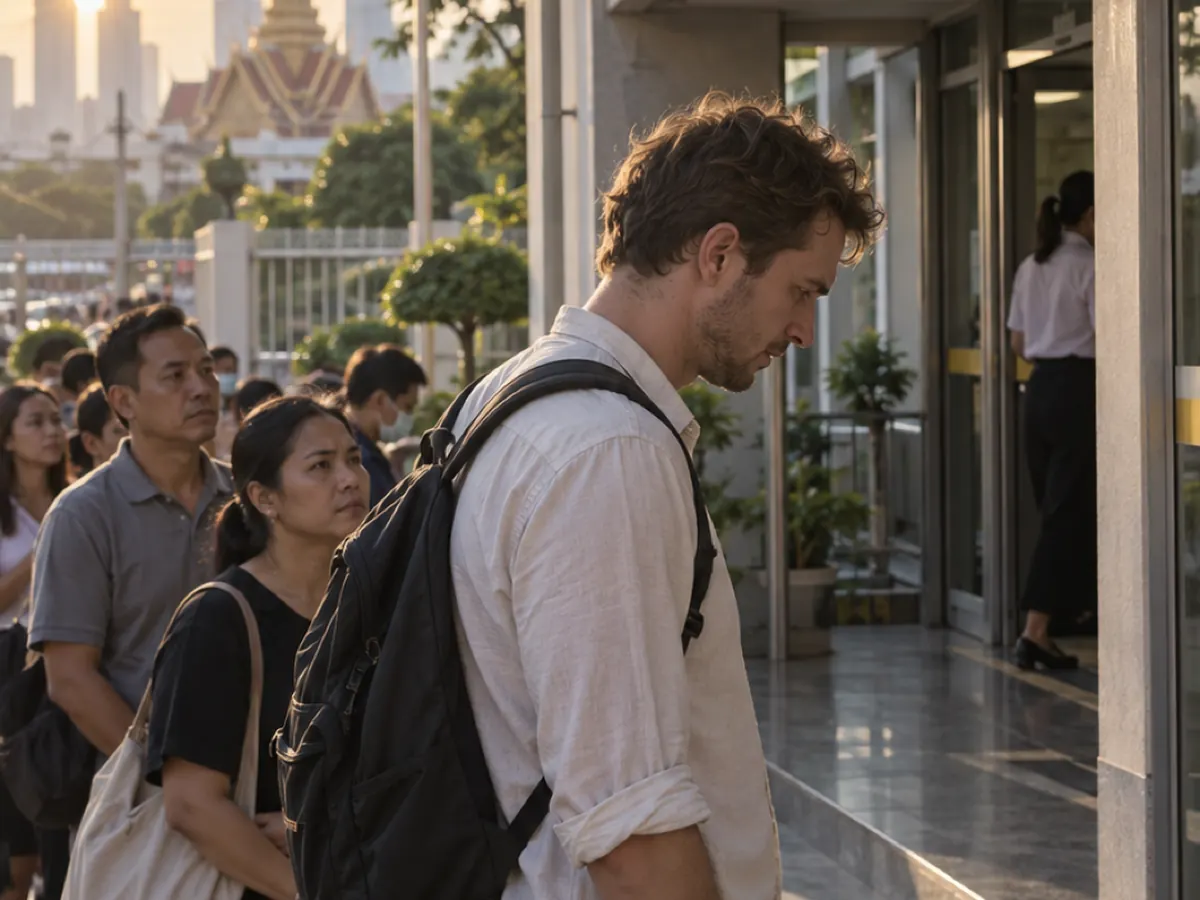
What I’d actually tell someone
If you’re on a long-term trajectory here, start the Thai language now. Not before the application — now, years before. It’s the requirement that cannot be crammed and the one most people fail on. Everything else is documents.
If you’re under the salary threshold and not married to a Thai national, be realistic. The routes are narrow and the employment one is the widest.
Don’t be deterred by the quota. It’s the most-quoted and least-relevant fact about the process for most nationalities.
And weigh it against the DTV. Article 01 Thailand long-stay visas compared: what each route really costs established the DTV as extraordinary value at ฿2,000 a year. It builds toward nothing. If your horizon is five years, that’s irrelevant. If it’s twenty, and you might want PR or citizenship, the cheap visa has a cost that doesn’t appear in the fee.

Common misconceptions
“The quota makes it impossible.” For most nationalities the quota isn’t reached. The requirements filter, not the cap.
“PR means citizenship.” It doesn’t. It’s usually a prerequisite for naturalisation, which is a separate and longer process.
“PR lets me own land.” It doesn’t. Article 16 Can foreigners actually own property in Thailand? What the agents don’t volunteer applies.
“I can apply any time.” There is one window a year and it moves — the last one ran 9 March to 3 April 2026.
“The language test is a formality.” It’s an interview, in Thai, and it’s assessed.
“It’s expensive to apply.” The application fee is ฿7,600. The permit itself, on approval, is ฿191,400 — ฿95,700 for the spouse or child of a Thai national or existing resident.
Common questions
- How many people get Thai permanent residence each year?
- The cap is 100 per nationality, plus 50 stateless applicants. For most nationalities fewer than 100 are granted, because fewer than 100 apply.
- What income do I need?
- For the working route, at least ฿80,000 a month for the two years before applying (or two years of tax returns on ฿100,000-plus annual income). The investment route requires at least ฿10 million invested in Thailand.
- Is there a Thai language requirement?
- Yes. Applicants are interviewed in Thai and language ability forms part of the assessment.
- When can I apply?
- There is one window a year, set once the quota notice is gazetted, and it moves: the latest ran from 9 March to 3 April 2026.
- How much does it cost?
- ฿7,600 to apply, non-refundable; ฿191,400 for the permit on approval, or ฿95,700 for the spouse or child of a Thai national or existing resident.
- How long does it take?
- Typically more than a year from submission to decision.
- Does PR let me own land?
- No. Land ownership restrictions still apply.