The fine nobody paid
Around 15% of Thai traffic tickets were being paid. Since 1 August 2026, unpaid fines block your vehicle tax disc, because two government databases finally talk to each other.

Reporting from 2019 found that of 6.2 million traffic tickets issued in Thailand since the start of that year, around 15% had been paid.
I’ll flag straight away that this figure is seven years old and I could not find a current equivalent — treat the number as a description of the problem that prompted the reform rather than as today’s rate. But the reform exists precisely because the problem did, and nobody has disputed the shape of it.
Eighty-five per cent unpaid.
At that rate a traffic fine is not a penalty. It is a letter, and everybody involved knows it’s a letter, including the officer writing it.
Why, which is not what you’d guess
The assumption most people reach for is corruption, or a cultural indifference to rules, and I want to dispatch that straight away because it’s lazy and it’s wrong.
The reason was that two government computer systems were not connected.
The Royal Thai Police issued the ticket. The Department of Land Transport renewed your annual vehicle tax. Neither knew what the other had done. So you could ignore a ticket entirely, walk into the DLT the following year, pay your tax, receive your disc and drive away, with no point at which the unpaid fine could surface.
The rule was real. The consequence wasn’t attached to anything.
Which is, structurally, exactly what article 80 Money you can wear identified in the gold market from the opposite direction. Gold works because the standard is enforced and the price is published — the mechanism binds. A traffic fine had a published amount and no mechanism at all. A rule you can ignore isn’t a weak rule. It’s a suggestion with an official font.
What changed on 1 August
Since 1 August 2026, unpaid traffic fines have blocked the issuing of your annual vehicle tax decal. The Royal Thai Police and the Department of Land Transport signed the agreement linking their electronic databases on 23 July 2026, and it bites on tickets issued from 1 August onwards.
The sequence runs:
Ticket issued. Ignored. A formal warning is posted. Still unpaid after 60 to 90 days, the police system updates and notifies the transport department. The debt is then attached to the vehicle.
And here is the mechanism precisely, because “you don’t get the disc” is not quite it. You can still pay your annual vehicle tax. What you do not receive is the real decal. Instead the system issues a temporary proof of payment valid for thirty days, and you get the actual decal once the fines are settled.
Which is a sharper piece of design than a flat refusal. The state takes your tax money, gives you thirty days of cover, and leaves you driving on a piece of paper with a clock on it. You are not locked out. You are put on notice, with a deadline attached to something you have to display.
Two details worth having straight:
It applies to new violations only. Tickets issued before August 2026 are not caught by it — which means the first renewals actually affected by this began falling due around October 2026, once the 60-to-90-day sequence had run on the earliest August tickets.
And the data won’t be visible immediately, motorists are expected to start seeing outstanding-fine information in the system around October or November 2026, which is when this becomes real rather than announced.

Why this matters more than it sounds
Article 78 The seven dangerous days looked at the 242 people who died on Thai roads during the Songkran week, found that 64.55% of crashes involved motorcycles and that 87.80% happened on straight roads, and concluded that the remaining safety gains were in helmets and alcohol rather than in engineering.
Here is the mechanism for delivering them.
The helmet fine was raised from ฿500 to up to ฿2,000 in the 2022 Road Traffic Act amendment. Speeding, running a red light, phone use and failing to stop at a crossing each carry up to ฿4,000.
None of which mattered at a 15% collection rate. Raising a fine that isn’t collected raises nothing.
And since 1 April 2026 the police have moved to strict enforcement of ten priority offences nationwide, helmets among them, under an approach reported as catch and actually fine. Put strict enforcement together with a collection mechanism and you have, for the first time, a deterrent that functions as one.
I’d add the honest caveat that enforcement drives in Thailand have a history of fading, and the test of this one is whether it’s still running in 2028. But this is a structural change rather than a campaign, and structural changes are harder to quietly stop.
The points system nobody knows about
While we’re here, because a surprising number of drivers in Thailand have no idea this exists.
Every Thai driving licence carries 12 demerit points.
One point: speeding, no helmet, phone use, no seatbelt, failing to stop for pedestrians. Two points: running a red light, driving the wrong way. Three points: hit and run. Four points: driving under the influence, street racing, reckless driving.
Which means three drink-driving offences exhausts a licence, and a driver collecting the routine one-pointers can run through twelve faster than they’d expect.
Practically
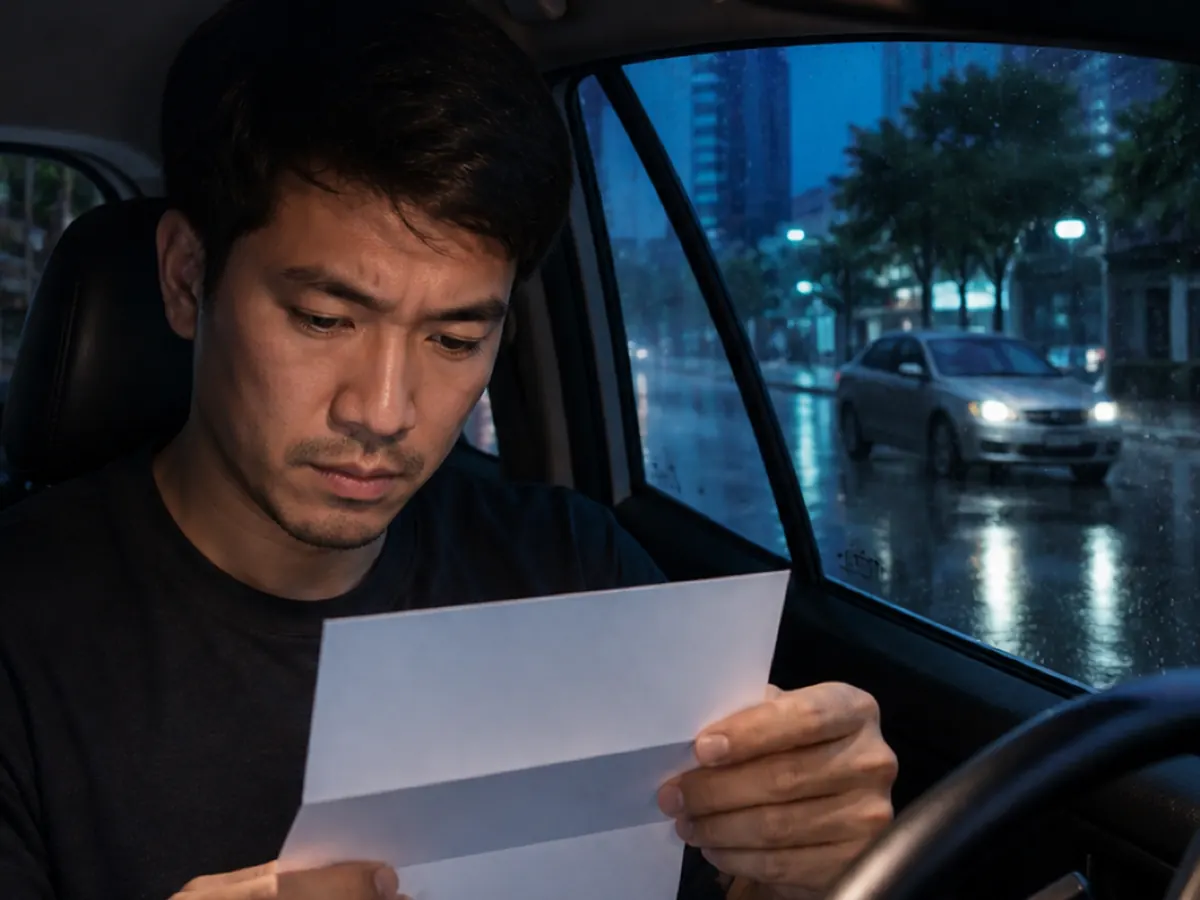
Check whether you have outstanding tickets before your tax renewal. Especially if you’ve moved — tickets are posted, and a letter to an old address is still a valid notification.
Pay them. You can pay at police stations, online, and through the same convenience store counter that article 61 The country that outsourced its public space described handling everything else in this country.
If you rent your vehicle, this is now the rental company’s problem and therefore yours — expect deposit terms to change as the August rule beds in.
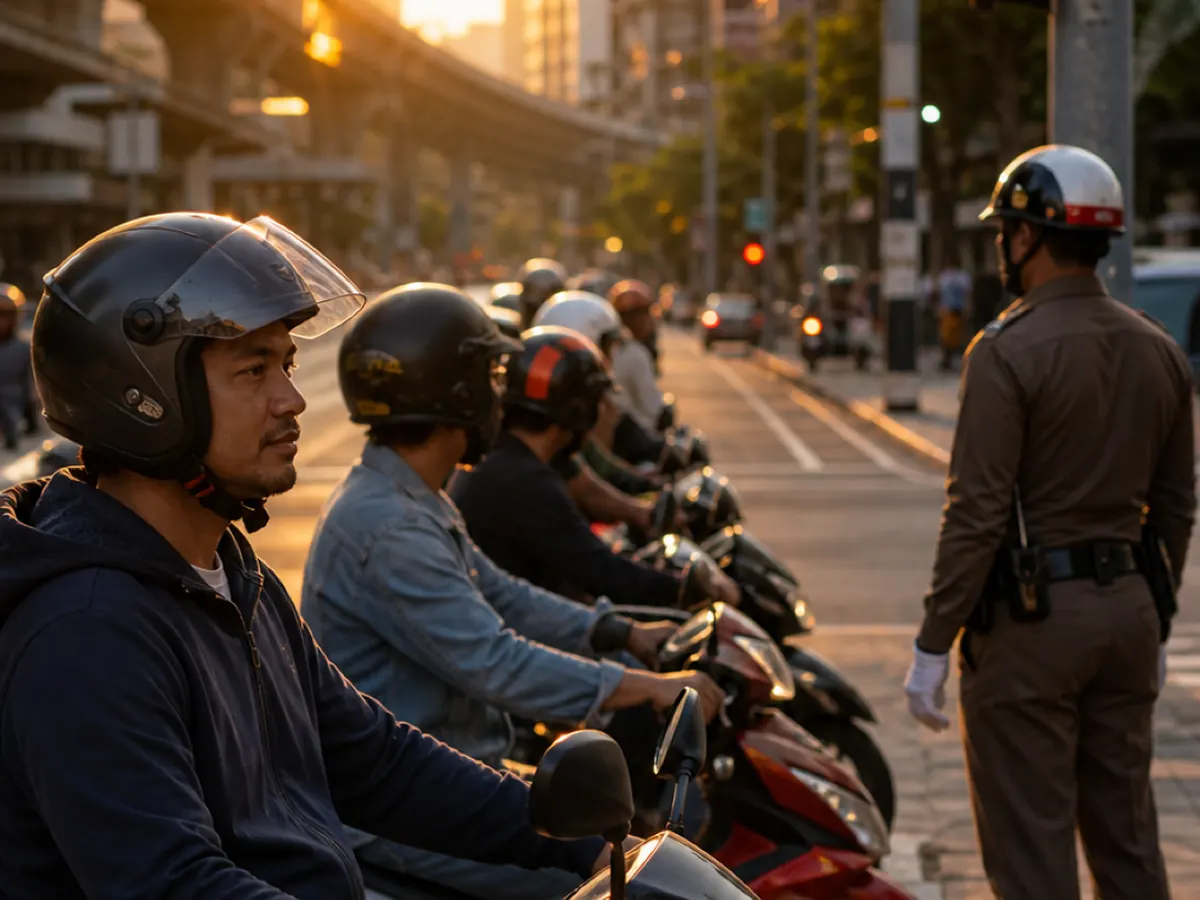
And if you ride, wear the helmet. ฿2,000 and a point, against article 78’s figures. The fine was never the argument, and now it’s also expensive.
Common misconceptions
“Thais don’t pay fines because of corruption.” The primary documented cause was that police and transport databases were not linked, so unpaid fines never surfaced at renewal.
“Traffic fines here are trivial.” Up to ฿4,000 for the four most-enforced offences, up to ฿2,000 for no helmet.
“There’s no licence points system.” There is: 12 points, with deductions from one to four depending on the offence.
“The August change affects my old tickets.” It applies to new violations only.
“Nothing ever gets enforced.” Strict enforcement of ten priority offences began on 1 April 2026, and the collection mechanism arrives on 1 August. Whether it persists is the open question.
Common questions
- What happens if you don't pay a traffic fine in Thailand?
- Since 1 August 2026, unpaid fines are attached to the vehicle after 60–90 days. You can still pay the annual tax, but you receive only a temporary proof of payment valid for thirty days instead of the real decal, until the fines are settled. It applies to tickets issued from 1 August 2026 onwards.
- Does this apply to old tickets?
- No. The rule covers violations from August 2026 onward.
- How much are Thai traffic fines?
- Up to ฿4,000 for speeding, red-light violations, phone use and failing to stop at crossings. Up to ฿2,000 for riding without a helmet.
- Is there a points system?
- Yes — 12 points per licence, with one to four deducted depending on the offence. Four points for drink-driving.
- Where can I pay a traffic fine?
- Police stations, online systems, and convenience store counters.
- When will I be able to see my outstanding fines?
- Reporting suggests the information appears in the system around October or November 2026.