No lawful version
A garland that sells for ฿20 pays ฿3 to whoever strung it and ฿8 to whoever stands in the traffic. And unlike every other informal Thai trade, this one has no route to being legal at all.
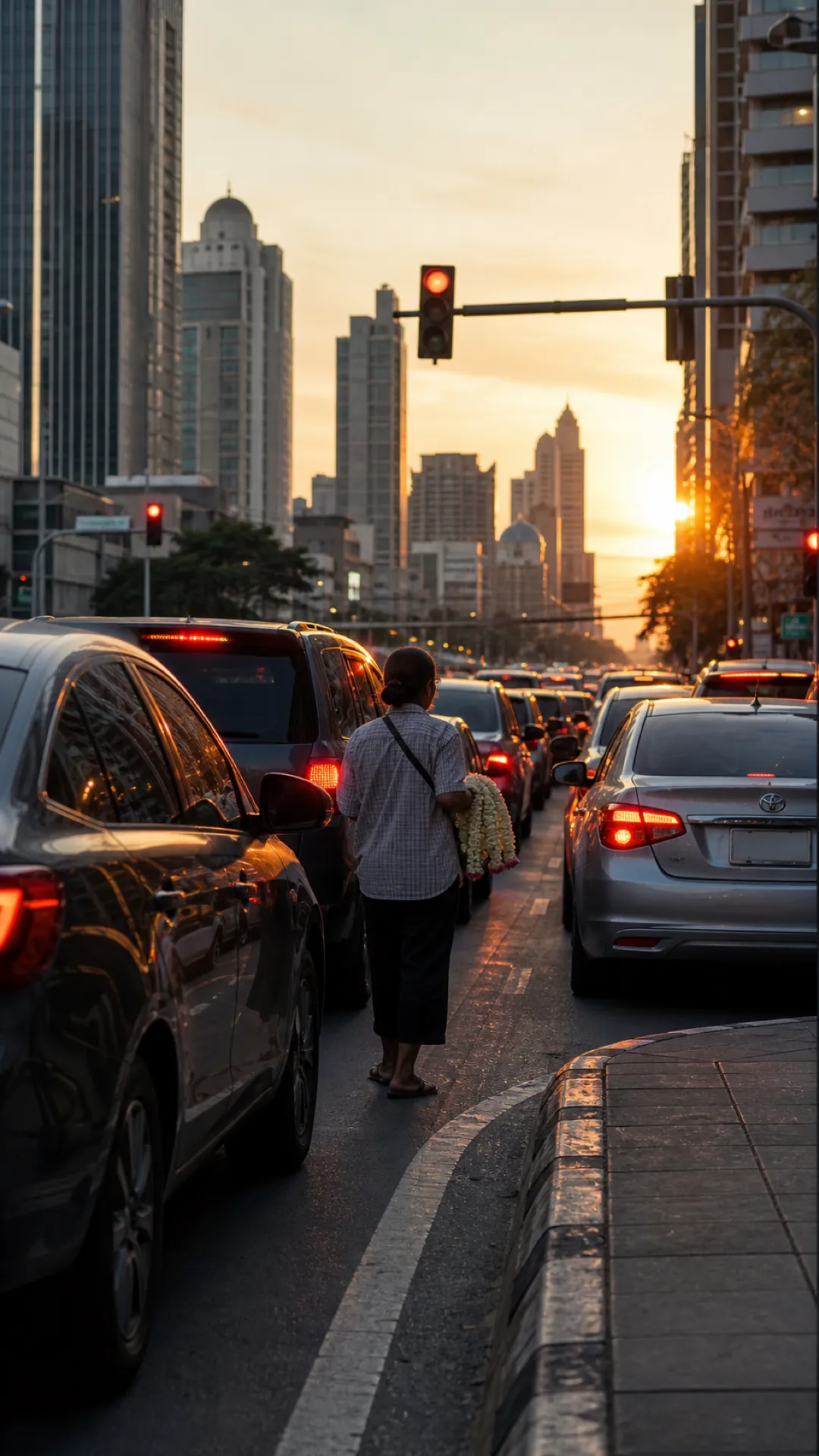
A jasmine garland at a Bangkok junction sells for ฿20.
According to Thai feature reporting on the trade, the person who strung it receives ฿3. The person who walks between the stopped cars to sell it receives ฿8. The remaining ฿9 goes to whoever supplied and organised.
The largest single share goes to the person who never enters the road.
That is the whole article in one line, but it is not the most interesting thing about this trade. The most interesting thing is that there is no lawful way to do it, and there is no prospect of one.
What this site has found everywhere else
The archive is largely a record of Thai informal work, and the pattern has been consistent.
Street food vendors were cleared, then partly readmitted through designated zones — a bad, contested, incomplete accommodation, but an accommodation. Motorcycle taxi riders got a registration, a queue and a numbered vest. Waste collectors sell into a real market with a real buyer at the end of it. Waste banks put a posted rate on a board next to a set of scales.
In every case the finding was some version of the same thing: the work is real, the protection is missing, and the fix is to give the existing arrangement a formal shape. Publish the price. Issue the registration. Draw the zone.
None of that is available here, and the reason is written down.
Section 110 of the Land Traffic Act B.E. 2522 (1979) is one sentence and it is the whole legal position:
No person shall buy, sell, distribute or solicit in a carriageway, or go out into the middle of the road without reasonable cause or in a manner obstructing traffic.
Three things follow from reading it rather than paraphrasing it.
The prohibited act is the trade, not the walking. An earlier version of this article said pedestrians may not be in a roadway except at a crossing. That is not what the Act says: section 103 requires a pedestrian to use the footway or shoulder where one exists, and to walk on the right-hand edge where one does not, and section 104 bars crossing outside a crossing only within a hundred metres of one. Being on foot in a road is sometimes lawful. Selling in one never is.
And neither is buying. Section 110 names the buyer in the same breath as the seller. The person in the car is committing the same offence as the person at the window, and I have not seen that stated anywhere in English or Thai coverage of this trade.
Then the part that decides the article. Look at what section 108 does two sentences earlier: it bans processions that obstruct traffic “except… a procession which a traffic officer has authorised, subject to the conditions the traffic officer prescribes.” The Act knows perfectly well how to write a permission route into a prohibition. Section 110 has no such clause. There is no authorising official, no conditions, no permit — not because the drafters forgot, but because the neighbouring section shows they were choosing.
So this is the one informal Thai occupation that cannot be formalised even in principle — not because nobody has tried, and not only because the thing itself is the hazard, but because the statute that prohibits it is the one statute in this archive with no door in it.
The penalty is a fine, under section 148, and I am not going to give you a figure for it. The last consolidated text of the Act I could obtain — the Council of State’s, current to 2019 — sets it at not more than ฿500. Section 148 was then amended by the Land Traffic Act (No. 13) B.E. 2565 (2022), which raised penalties across the Act, and I could not obtain the amended wording: the Royal Gazette blocks automated access and every consolidation I could reach stops before it. So the offence carries a small fixed fine and I can tell you where it is written but not, honestly, what it now is.
Which decides how everyone is treated
Follow that through and the consequences are not small.
If a trade cannot be regulated, the only instruments left are enforcement and removal.
There is no third option. No inspectorate, because there is nothing to inspect to a standard. No permit, because a permit would be a licence to stand in traffic. No safety rules, because the safety rule is do not be there. The entire policy vocabulary available for these people is the vocabulary of clearing them.
That is true of the adults. It is not true of the children, and the difference is a whole separate statute — which is two sections below and is the strongest thing in this article.
Which means that in every official encounter, the person is a traffic matter first. Not a worker with no employer, not a household with no other income — a pedestrian in a carriageway, which is an offence.
And that framing is actively in the way when the person is a child — but here, and only here, the argument I have just made stops being true.
Thai reporting describes groups of around fifteen people aged roughly ten to eighteen working the windscreens at Bangkok junctions, with younger children asking for money among stopped cars. The Department of Children and Youth Affairs has described the state’s aim as getting children out of street selling, noting that it is both dangerous and a traffic violation — and that pairing is the problem in miniature.
Because there is a second law, and it is not a traffic law.
The Child Protection Act B.E. 2546 (2003), section 26, opens with the words “whether or not the child consents” and then prohibits, among ten things:
(5) compelling, threatening, inducing, encouraging, permitting or by any means causing a child to become a beggar or a street child, using a child as an instrument in begging or in wrongdoing, or doing anything that unlawfully exploits a child;
(6) using, hiring or asking a child to work or do anything that may be dangerous to the body or mind, affect the child’s growth, or obstruct the child’s development.
A child is anyone under eighteen under the same Act. Breach of section 26 carries up to three months’ imprisonment or a fine of up to ฿30,000, or both — sixty times the traffic fine, and aimed at an entirely different person.
That is the point. The traffic offence is committed by the child in the road. The child-protection offence is committed by whoever put them there, it does not require the traffic law at all, and the child’s own willingness is expressly irrelevant to it.
And there is a duty as well as an offence. Section 32 lists the children who should receive welfare assistance and its first entry is street children; its fifth is a child used as an instrument of unlawful exploitation. Section 33 then requires a competent officer who finds such a child to provide assistance by prescribed means, beginning with helping the family to be able to care for the child.
So the sentence I wrote two sections ago — that enforcement and removal are the only instruments available — is true of the adults and false of the children. For a child at a junction the state already has an offence aimed at the organiser and a positive duty aimed at the child, both written and both in force since 2003.
A child working in live traffic is a child-protection case that arrives dressed as a traffic offence. The powers exist. What differs is which agency turns up, and a police officer at a junction is enforcing the small one.
Thai media have been asking the right question about this for years and framing it plainly. The debate is not whether it is sad. It is whether selling at intersections is earning a living or child labour, and whether the transaction is sympathy or a business model. Those are the Thai headlines, not my characterisation, and they are considerably less sentimental than the English-language version of this subject.
The ninety-second market
The economics deserve a moment on their own, because they are unusual.
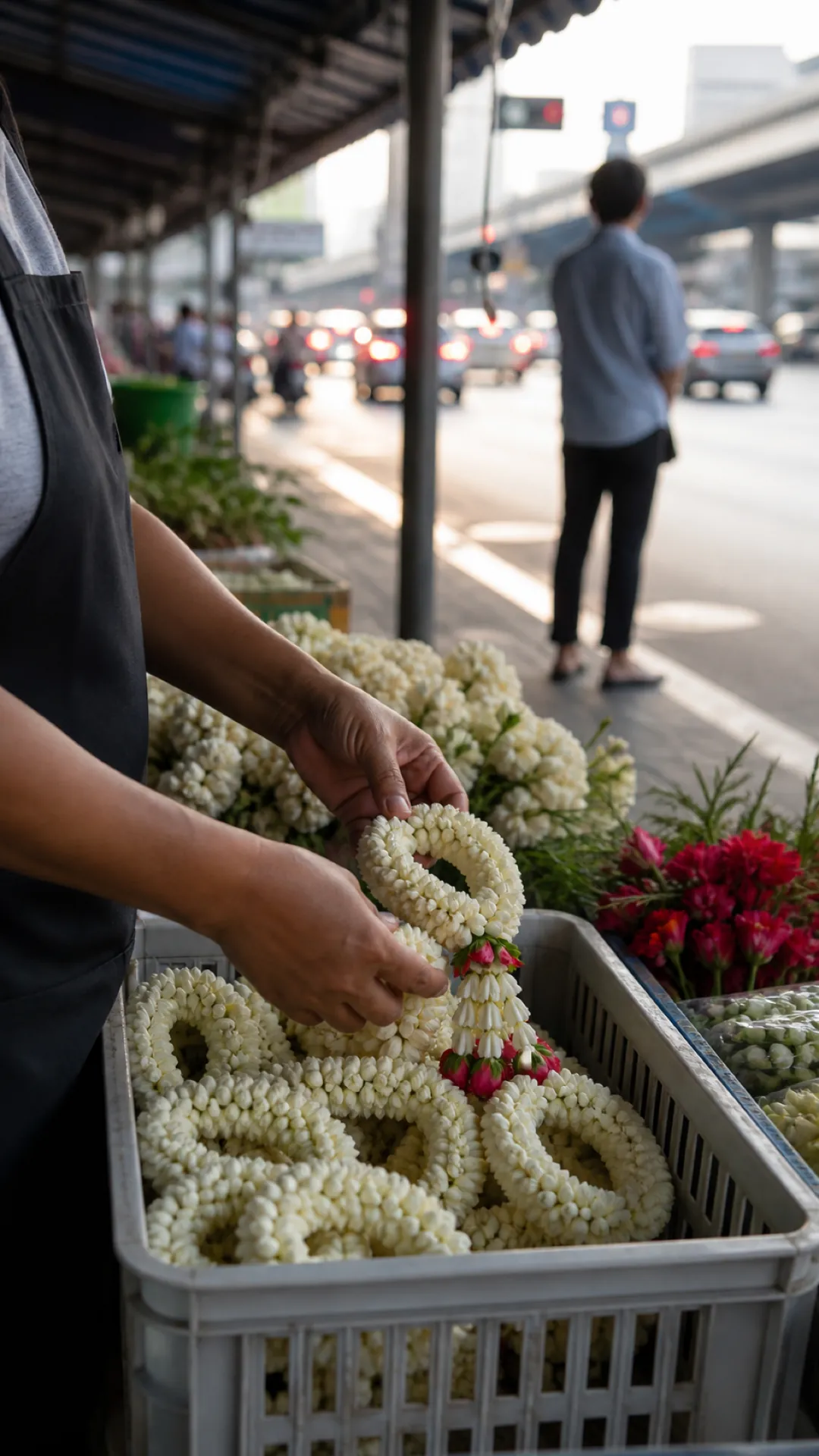
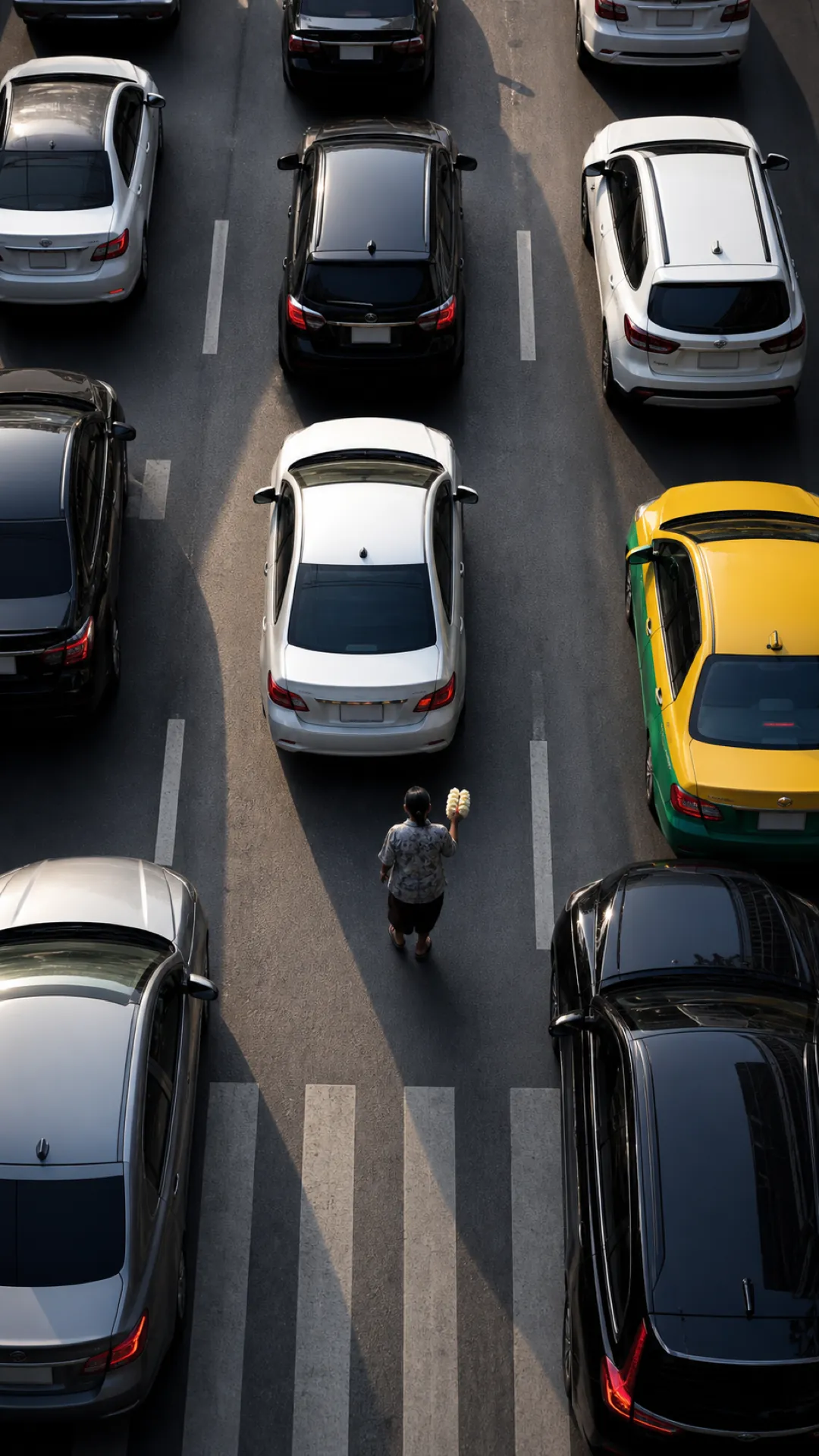
A red light is a market that opens for sixty to ninety seconds and then closes. During it, the customers are stationary, enclosed, and cannot leave. Then they all leave at once.
That produces a business with properties nothing else has. Inventory must be tiny and instantly transferable. Price must be a single round number requiring no negotiation and no change. The pitch must complete in under a minute. And crucially, the seller’s total addressable market for the day is set by the signal timing, which is a public infrastructure parameter decided by traffic engineers who are not thinking about anybody’s income.
Their working conditions are set by the length of a red light and their earnings by how many cars fit in it. I don’t think there is another job in the country of which that is literally true.
Set the ฿3 / ฿8 / ฿20 split against that. The risk in this trade is entirely borne at the point of sale — the physical risk of the carriageway, the enforcement risk, the weather. And the person bearing all of it takes ฿8 of ฿20, while the largest share goes to the part of the chain that stays on the pavement. Risk and reward run in opposite directions, and the direction is the same one this site keeps finding.
The windscreen, which is a different transaction
Now the part people actually argue about, and it deserves better than a complaint.
Selling a garland and cleaning a windscreen are not the same economic act.
A garland is an offer. It is held up, you decline or you don’t, and if you decline nothing has happened. The consent comes before the delivery, which is how nearly every transaction works.
A windscreen wash is delivered first. The cloth is on the glass before any price is agreed and usually before any agreement at all. By the time you can respond, the service exists and cannot be returned.
That is why it produces friction that garland-selling doesn’t, and the friction is structural rather than moral. A transaction in which delivery precedes consent has no comfortable version for either party. The motorist experiences an obligation they did not accept. The cleaner has performed work with no way to compel payment and no way to have been refused before doing it.
And it takes that form for a reason. If you have nothing to sell — no stock, no product, no ฿3 garland — the only asset available is a service you can perform unilaterally. Delivering first is not a trick. It is the only structure available to someone whose entire inventory is their own labour and a bottle of water.
Which explains the behaviour without excusing anything or requiring anyone to feel differently about it. You are allowed to find it unwelcome. It is worth knowing why it takes exactly that shape.
What I can’t tell you
I have no estimate of how many people do this, in Bangkok or nationally. I looked. Nobody appears to count, which is itself consistent with everything above — you do not produce statistics about a population you only address by removing.
I have no injury or fatality data for vendors at intersections. Given that articles 78 and 114 both established how well Thailand counts road deaths in other contexts, the absence here is conspicuous. It is the single most useful missing number and I could not find it.
The ฿3 / ฿8 / ฿20 split is from one feature interview. It is specific, plausible and consistent with the structure, and it is one source. It should not be treated as a national average and it is not stated as one.
And I have no idea how much of the windscreen-cleaning at any junction is independent and how much is organised by somebody else. Thai reporting uses the word “gang”. I am not going to extrapolate from a word.
Practically
You are not obliged to buy anything, and declining is normal. A small shake of the head is understood and is not rude. The transaction most Thais have with a garland seller is brief, unsentimental and mutual.
And worth knowing, because nobody says it: buying is an offence too. Section 110 prohibits buying in a carriageway in the same clause as selling. In practice the person prosecuted is the one standing in the road, which is the article’s argument arriving at your own window.
If you don’t want your windscreen cleaned, signal before it starts — wipers on, or a hand up. Once it has started, the useful thing to know is that ฿20 ends it and an argument doesn’t.
Buying is not charity and it isn’t a fix. A garland is a real object at a real price. If you want the ฿8 to be a larger number, that is a supply-chain question and not a tipping question.
And keep your window mostly up in traffic — the ordinary advice, for the ordinary reason, and nothing to do with who is outside it.
Common misconceptions
“They could get a licence.” No licence exists and none could be issued. Section 110 of the Land Traffic Act bans buying, selling, distributing or soliciting in a carriageway with no permission clause at all — unlike section 108 two sentences earlier, which bans obstructive processions except those a traffic officer authorises on conditions.
“It’s the same as street food vending.” Street vending has designated zones, however contested. There is no zone that can be drawn in a junction.
“The seller keeps the ฿20.” In the one documented breakdown, the seller receives ฿8, the person who strung the garland ฿3, and ฿9 goes elsewhere in the chain.
“The windscreen cleaners are being aggressive.” The service is delivered before consent because unilateral delivery is the only structure available to someone with no stock. That explains the friction; it doesn’t require anyone to enjoy it.
“Nobody in Thailand is worried about the children.” Thai media have covered it as a child-labour question for years, the Department of Children and Youth Affairs has stated the aim of getting children out of street selling, and the Child Protection Act has prohibited using or asking a child to do dangerous work since 2003.
“There’s no law against sending a child into traffic to sell.” There is. Child Protection Act section 26(6), regardless of whether the child agrees, punishable by up to three months’ imprisonment or ฿30,000. The traffic offence the child commits carries a small fine under section 148 of the Land Traffic Act.
Common questions
- What do vendors sell at Thai traffic lights?
- Most commonly jasmine garlands, along with drinks, snacks, cloths and small household items. Windscreen cleaning is offered as a service rather than a product.
- How much do traffic light vendors earn?
- One documented breakdown of the garland trade gives ฿8 to the seller from a ฿20 garland, with ฿3 to the person who strung it. This is a single reported case, not a national figure.
- Is selling at traffic lights legal in Thailand?
- No. Section 110 of the Land Traffic Act B.E. 2522 (1979) prohibits buying, selling, distributing or soliciting in a carriageway, penalised by a fine under section 148. The section contains no permit or authorisation clause, so there is nothing that could be applied for.
- Is buying from a vendor at a red light an offence?
- Under section 110, yes — buying is prohibited in the same clause as selling. In practice the person penalised is the one standing in the road.
- Why can't the trade be regulated like street food?
- Street vending can be moved into designated zones. A junction cannot contain one, and the statute that bans the trade has no authorisation clause — unlike section 108 two sentences earlier, which allows a traffic officer to authorise an obstructive procession on conditions.
- What does Thai law say about children selling at intersections?
- The Child Protection Act B.E. 2546 (2003) section 26 prohibits, whether or not the child agrees, causing a child to become a street child or using a child as an instrument of unlawful exploitation, and using, hiring or asking a child to do work that may be dangerous to body or mind. A child is anyone under eighteen. Breach carries up to three months' imprisonment or a fine of up to ฿30,000. The Act also lists street children among those who should receive welfare assistance.
- Do I have to pay for a windscreen clean I didn't ask for?
- There is no obligation. The service is typically delivered before it is agreed, which is what makes it uncomfortable; a small note ends the interaction faster than a discussion.
- Are children working at Thai intersections?
- Thai reporting has documented groups including minors at Bangkok junctions, and the Department of Children and Youth Affairs has described efforts to remove children from street selling.