It cannot be closed
Rama II Road has been under construction for 56 years. The reason is not incompetence — 259,277 vehicles a day use the only main route to the South, so it has to be rebuilt around itself.
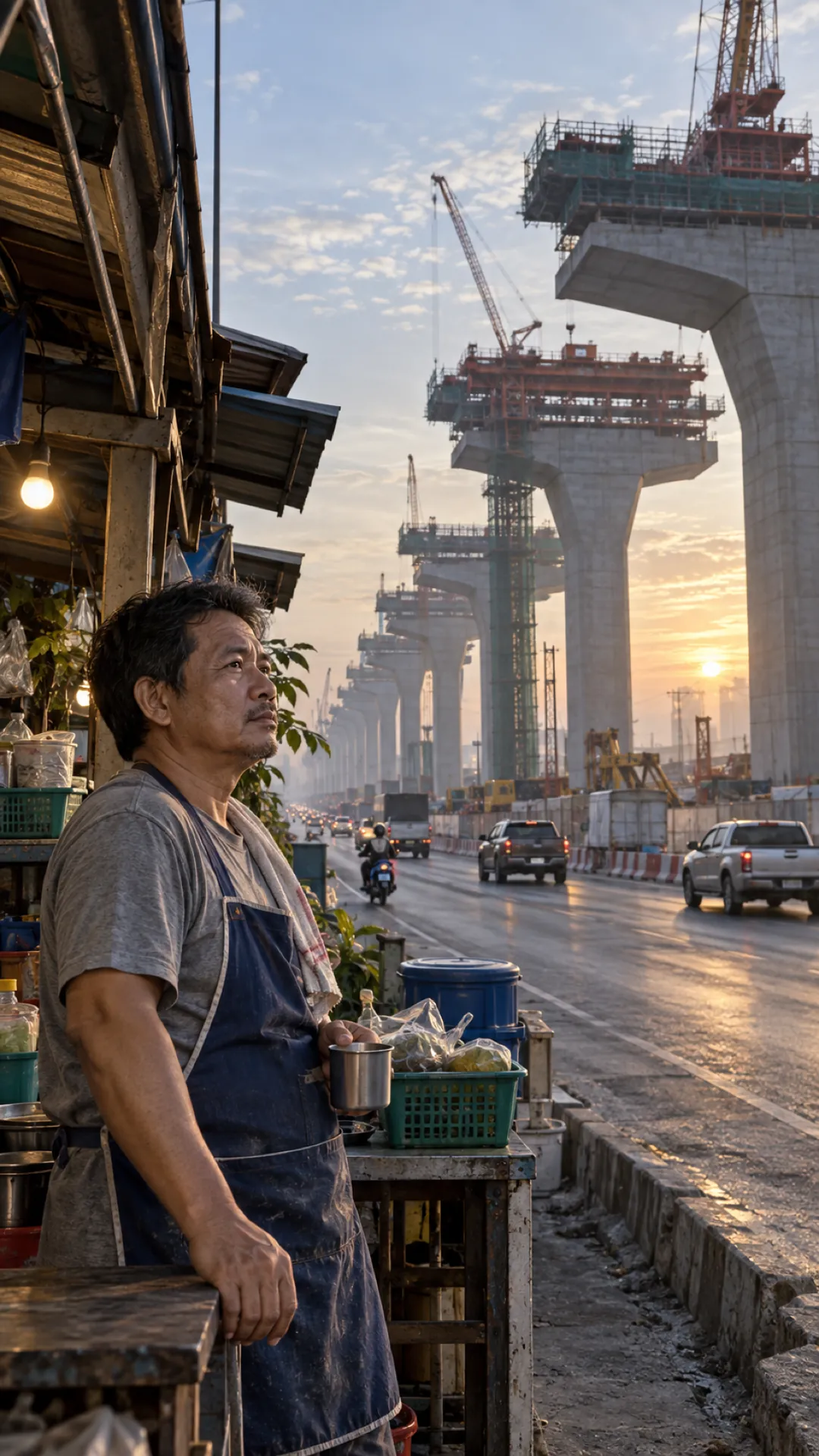
Work began on Rama II Road in 1970. It opened on 1 April 1973.
It has been under construction, in one section or another, more or less continuously ever since. Fifty-six years. Thai media have taken to measuring it against the Great Pyramid of Giza, which is unkind and roughly accurate.
There is a Thai phrase for this kind of project — ถนนเจ็ดชั่วโคตร, the road of seven generations — and Rama II is what the phrase now means.
The usual explanation is incompetence, or corruption, or both. I don’t think either is the interesting answer, and neither is the one that tells you what would fix it.
What the road is
Rama II is the main land route from Bangkok to the entire southern region. Not the fastest, or the most scenic. The main one. It is Highway 35, and the Department of Highways counts it in five sections.
259,277 vehicles a day on the Bangkok end, at Dao Khanong to Samae Dam, in the department’s 2025 count. That is the number people mean when they say Rama II. The rest of the route is thinner and heavier:
| Section | Vehicles a day | Heavy vehicles |
|---|---|---|
| Dao Khanong – Samae Dam | 259,277 | 10.1% |
| Samae Dam – Tha Chin bridge | 143,116 | 37.4% |
| Tha Chin bridge – Na Khok | 149,785 | 35.8% |
| Na Khok – Phraek Nam Daeng | 64,247 | 50.7% |
| Phraek Nam Daeng – Wang Manao | 82,650 | 48.6% |
That last column is the argument. Traffic thins as you go south and the load does not: by Na Khok, half of everything on the road is a lorry. This is not a commuter road that also carries freight. It is a freight corridor with a city on one end.
Samut Sakhon, the province it runs through for most of its length, held 6,832 registered factories at the end of 2025 on the Department of Industrial Works’ count. Everything those factories move by road, plus produce, tourism and the whole peninsula’s overland traffic, goes down this road.
There is no parallel route of equivalent capacity.
Hold that together with the table, because their product is the entire article.
The consequence
A road that carries a quarter of a million vehicles a day at one end and half the South’s lorries at the other cannot be closed to be rebuilt.
That is not an engineering judgement, it is an economic one, and it has been made the same way by every administration that has looked at it. Shutting the corridor means shutting the freight route for a third of the country. So it stays open, and the work happens around it.
Which in practice means: lane by lane. At night. In slivers. With girders and gantries lifted over live traffic, because the space beside the road is a canal, a factory wall, or somebody’s house, and the only place to put a new road is above the old one.
That is the method. And the method is what has been killing people.
This article previously reported “around 2,500 incidents, 144 dead and 1,411 injured” over about eight years, from Thai press compilations. Those figures are not used here any more. They were assembled by outlets with different windows and different rules about whether ordinary traffic collisions count, and no two versions agreed. What follows instead is the Department of Highways’ own record.
The department publishes traffic accidents by control section every year. For the busiest section, Dao Khanong to Samae Dam — 14.66 kilometres of the Bangkok end — the eight years read:
| Year | Accidents | Deaths | Injuries |
|---|---|---|---|
| 2018 | 43 | 1 | 17 |
| 2019 | 101 | – | 47 |
| 2020 | 138 | 1 | 87 |
| 2021 | 45 | 2 | 20 |
| 2022 | 91 | – | 59 |
| 2023 | 229 | 16 | 157 |
| 2024 | 295 | 6 | 199 |
| 2025 | 318 | 13 | 193 |
Accidents on that fourteen kilometres have gone up sevenfold since 2018 and have roughly trebled since 2021. In 2025 the department ranked it the third most accident-dense stretch of national highway in Thailand, at 21.69 accidents per kilometre.
Three things must be said about that table before anyone uses it.
It is one section. Rama II is five. The department’s route table only lists sections above a threshold, so it publishes no whole-corridor total — which is exactly why the press compilations exist and exactly why they disagree.
It counts traffic accidents, not collapses. A girder coming down and a rear-end shunt in a coned-off lane are the same row in this table. The series is evidence that the corridor became far more dangerous to drive on while it was being rebuilt around live traffic. It is not a count of people killed by falling structures, and I am not going to present it as one.
And the department did not attribute any of it to the works. That is my reading of a rise that coincides with them, and it is stated as a reading.
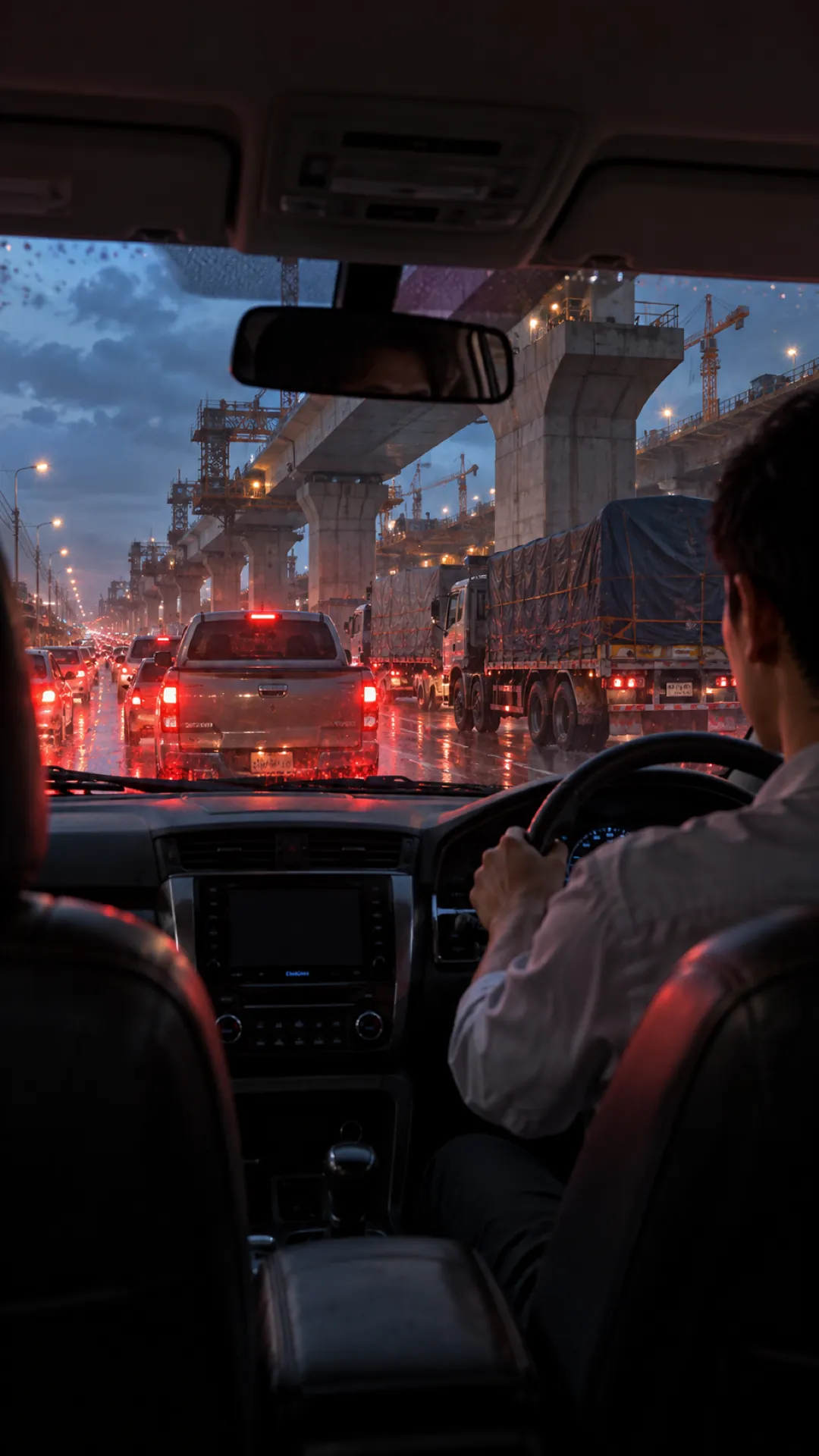
The pattern in the serious structural incidents is consistent enough to state without describing any of them: November 2024, March 2025 and January 2026 all involved structural elements or lifting equipment coming down. Onto a road.
A road that was open, because it could not be shut.
Why this is article 65’s bill
The site has argued that Bangkok’s dominance is the organising fact of the country — that Thailand is a capital with a nation attached rather than the other way round, and that almost every problem in the archive is that shape seen from a different angle.
This is what that costs when you write it in concrete.
A country with three southern corridors can close one. A country with one cannot. The absence of an alternative is not a separate problem from the permanent construction; it is the cause of it, and it is also why every fix proposed for the past two decades has been a version of build more capacity on the same alignment — widen it, then widen it again, then put a road on top of it.
The road went from 4 lanes to 8, then to 10, then to 14, and then acquired an elevated motorway above it. Each expansion was necessary. Each expansion required years of work beside live traffic. Each expansion increased the number of vehicles for which no closure would ever again be possible.
A corridor with no substitute gets locked into permanent reconstruction, and every improvement tightens the lock.
What was said to have changed, and what actually did
An earlier version of this article said the main carriageway was closed for four months from February 2026 — properly closed, to let the work finish without traffic underneath it — and called that the admission that the method had to stop. That is not what happened, and the correction is more interesting than the claim.
What was announced was the closure of the main-carriageway flyover at the Bang Khun Thian interchange, kilometre 9+500 to 10+700 — one thousand two hundred metres — twenty-four hours a day from 11 February to 15 June 2026, so that bridge segments could be installed for a separate expressway scheme. The parallel carriageway stayed open as the diversion. Traffic was routed off the main road at km 8+945 and back on at km 10+800.
So the road was not closed. Even the largest shutdown of the period was two lanes over one and a bit kilometres, with everything else still moving underneath the lifting. The method did not stop. It cannot stop, which is the article’s whole point, and I had briefly written the opposite.
What actually changed, on 28 August 2026
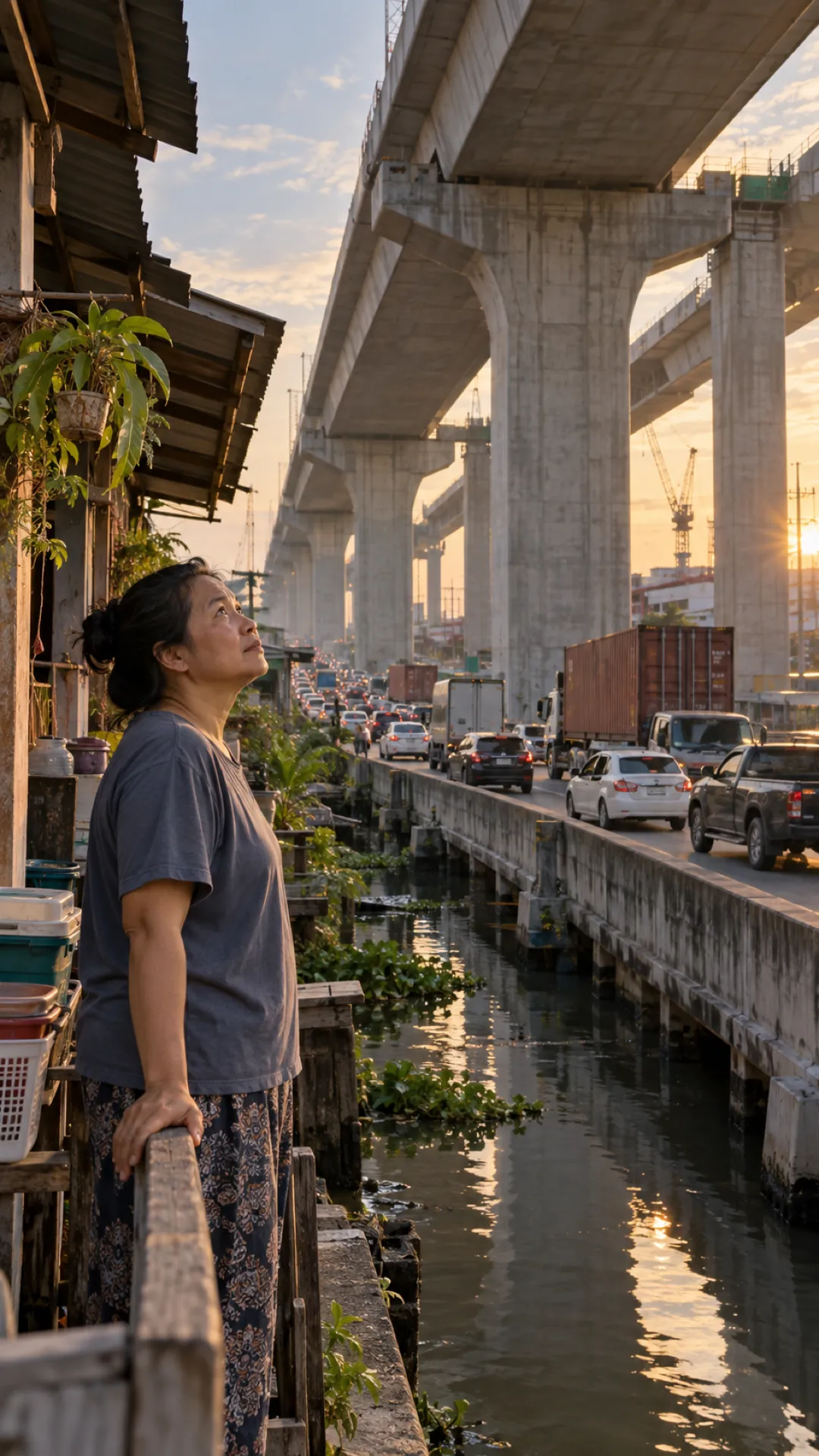
The elevated motorway opened.
At ten in the morning on 28 August 2026, the section from Ekkachai to Ban Phaeo — 16.4 kilometres — was opened for trial use, joining the Bang Khun Thian to Ekkachai section already running. That gives about 25 continuous kilometres of elevated road above Rama II, open around the clock, with no toll.
The government’s announcement described it as closing the legend of the seven-generations road, under a policy heading of Quick Wins.
The same announcement says the project is not finished. Four ramps are open — Phan Thai Norasing, Maha Chai 1, Maha Chai 2, Ban Phaeo — and two more, Samut Sakhon 1 and Samut Sakhon 2, are still under construction. Full opening, with tolling, is targeted for 2029. And because the construction and the safety-management systems are not complete, cars are held to 80 km/h and lorries and buses to 65.
One line in that announcement is the site’s second structural finding in a sentence. Pedestrians, bicycles, motorcycles of every engine size, three-wheelers and every other wheeled vehicle are not permitted on the elevated road. They stay on Rama II underneath, with the lorries and the works. At the Bangkok end the department counted 4,523 motorcycles and three-wheelers a day on the surface road. The new capacity is real, and it is available to people who already had a car.
A road announced as nearly finished many times over 56 years has trained an entire country to hear the announcement as weather. This time something genuinely opened. It also has three more years to run, on the same road, over the same traffic.
What would actually fix it
Only one thing, and it isn’t on Rama II.
A second corridor. Not more lanes on this one — a genuinely separate southern route with enough capacity that closing either becomes possible. That is the only intervention that breaks the lock, and it is expensive, slow, and politically far less legible than another flyover on a road everyone already complains about.
Everything else is maintenance on a road that can never stop being maintained, and the elevated motorway that opened in August is the largest and most expensive version of everything else. It is more capacity on the same alignment, built above the alignment because there was nowhere else to put it, and it took eleven years.
Practically
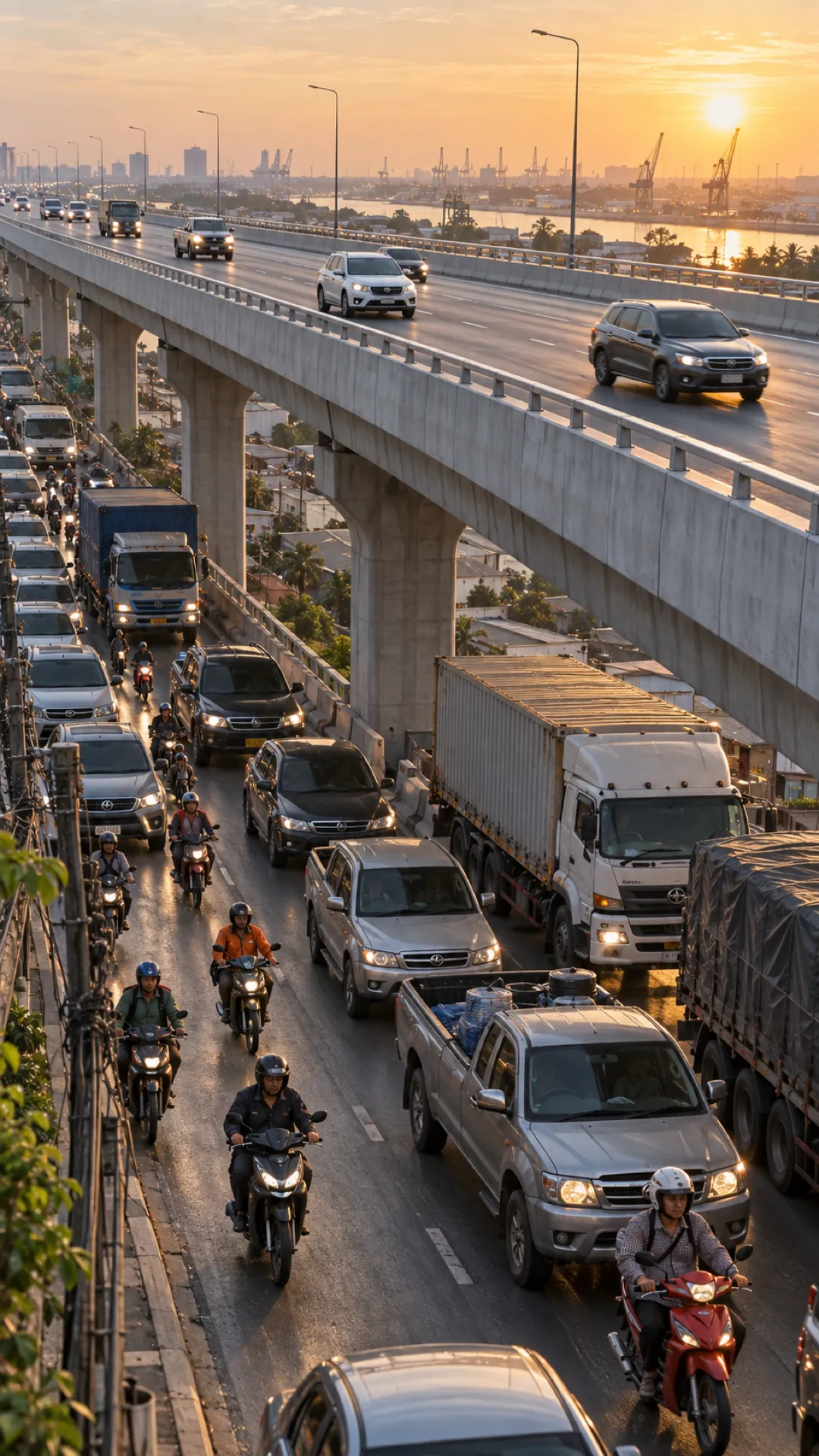
If you are driving south: check the current closure status before you set off rather than en route. Configurations have changed repeatedly and satnav has been consistently behind them.
If you are quoted a journey time to Hua Hin or further: the quote is optimistic. It has been optimistic for about twenty years.
And if you work on it: article 86 Outside is not a workplace is about who counts as being in a workplace under Thai law, and it is relevant here in a way that is not comfortable.
Common misconceptions
“They just keep failing to finish it.” They keep finishing projects. There is always another one, because capacity keeps needing to be added to a corridor that cannot be taken out of service to add it.
“Why don’t they just close the road and build it properly?” 259,277 vehicles a day at the Bangkok end, half the traffic further south being lorries, and it is the main land route to the entire South. The largest shutdown of recent years closed two lanes over 1.2 kilometres for four months, with the parallel carriageway carrying the diversion. The road itself has never been closed.
“It’s one project that’s overrunning.” It is a sequence: 4 lanes to 8, to 10, to 14, plus an elevated motorway and a separate expressway scheme, across five decades.
“The accidents are ordinary road accidents.” The Department of Highways series counts traffic accidents, and it rose sevenfold on the busiest section between 2018 and 2025. The serious structural incidents — girders and lifting equipment coming down onto the carriageway — are a separate and smaller category that the traffic series does not isolate.
“It’s finished — the motorway opened in August.” Twenty-five kilometres of it opened for trial use on 28 August 2026, free and with reduced speed limits. Two ramps are still being built and the government’s own target for full opening with tolls is 2029.
Common questions
- How long has Rama II Road been under construction?
- Work began in 1970 and the road opened in 1973. It has been under near-continuous construction in one section or another since — over fifty years.
- Why is Rama II Road never finished?
- It is the main land route between Bangkok and southern Thailand, carrying 259,277 vehicles a day at its busiest section on the Department of Highways' 2025 count, with no parallel route of comparable capacity. It cannot be closed for reconstruction, so successive expansions have been built alongside and above live traffic, which is slow.
- How many people have died on Rama II Road?
- There is no published whole-corridor total. On the Department of Highways' own record for the busiest section, Dao Khanong to Samae Dam, 39 people were killed and 779 injured in 1,260 traffic accidents between 2018 and 2025, with the annual count rising from 43 to 318. Widely circulated press compilations giving larger totals are assembled from different windows and different inclusion rules and are not an official series.
- Was Rama II Road ever closed for the works?
- No. The largest recent shutdown closed two of four main-carriageway lanes over 1.2 kilometres at the Bang Khun Thian interchange, from 11 February to 15 June 2026, with the parallel carriageway carrying the diverted traffic.
- When will Rama II Road be finished?
- Twenty-five kilometres of the elevated motorway opened for trial use on 28 August 2026, toll-free and with reduced speed limits. Two ramps are still under construction and the government's target for full opening with tolling is 2029.
- What does ถนนเจ็ดชั่วโคตร mean?
- Literally "the road of seven generations" — a Thai phrase for roadworks that never end. Rama II is the example the phrase is now used for.