Nobody is turned away
Around half of Thais surveyed said they turn to มูเตลู when money runs short. Lower earners go more often than higher ones. It is the only risk product in the country with no eligibility criteria at all.

Roughly half the people in a 1,213-person survey said that when they run into money trouble — a payment they can’t make, an investment that went wrong — they turn to มูเตลู.
Among Gen Y, the cohort currently carrying most of the country’s working-age debt, it was 59.2%, and the researchers calculated they were 1.7 times more likely to do it than anyone else.
I want to take that seriously rather than smile at it, because taken seriously it is one of the more revealing numbers anyone has published about how Thai households manage risk.
What the word covers
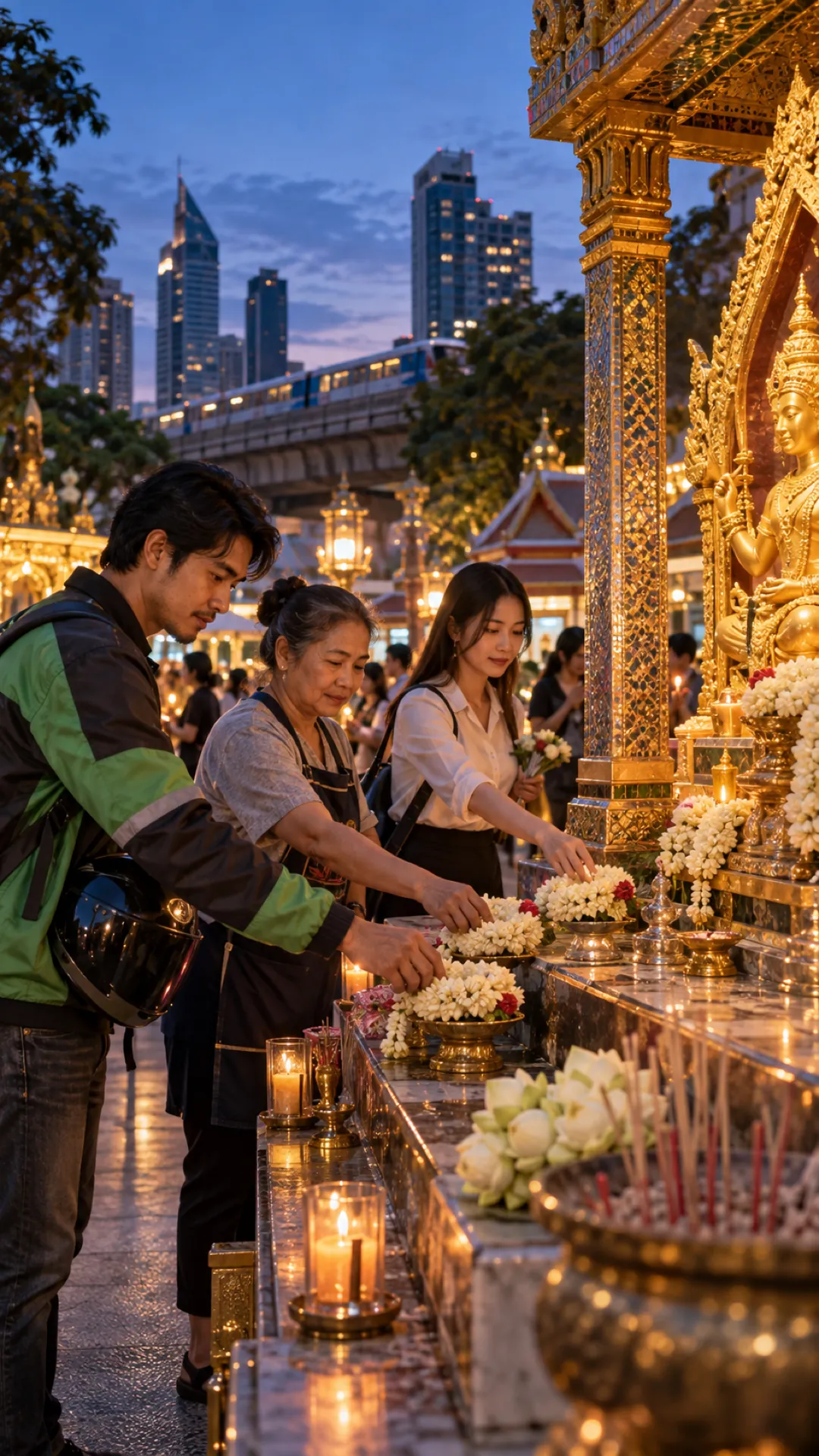
มูเตลู entered Thai from the title of an Indonesian film and has been doing a job the language needed ever since. It covers the whole territory outside formal religious practice: having your fortune told, buying an amulet or an auspicious object, changing your name or your phone number or your number plate, choosing a lucky colour for a car, travelling to make an offering somewhere.
สายมู is what you call someone who does it. There is no good English word for either, and the closest attempts — superstition, the occult — both smuggle in a verdict.
The scale is a matter of some dispute, which is itself interesting. The University of the Thai Chamber of Commerce put ฿10–15 billion circulating through belief-related businesses in 2024. The Department of Business Development register tells a completely different story: 164 active companies under the astrology-and-occult classification, ฿181 million of registered capital between them, 72% of them in Bangkok and the surrounding provinces.
Both can be true and the gap is the point. Almost none of this money passes through anything that files accounts.
The finding
Here is what the survey shows when you stop looking at it as consumer research.
More than 8 in 10 respondents had done at least one มูเตลู activity. By generation: Gen X 90.7%, Gen Y 82.9%, Gen Z 78.5%, Baby Boomers 67.8%. Note which way that runs — the youngest group is not the least involved, and the oldest is.
47.5% travel to make an offering at least every three months. And within that:
Lower earners go more often than higher earners. Respondents earning under ฿75,000 a month were 1.7 times more likely to be making those trips than those earning over ฿150,000.
Lower earners buy online more, too. Under ฿30,000 a month, respondents were 2.2 times more likely to have bought มูเตลู goods online than the over-฿150,000 group.
And the reach-for-it-in-trouble figure runs the same direction by age: Gen Y 59.2%, Gen Z 53.7%, Gen X 43.6%, Baby Boomers 32.2%.
There is a countervailing number and it belongs here rather than in a footnote. Spending per head rises with income — the share spending over ฿1,000 a year climbs steadily with earnings, and the highest earners have the largest share spending over ฿5,000. So the rich spend more and the poor go more often, which are different behaviours and should not be blurred into one.
The frequency is the finding. Not the amount.
Why this is article 89 again, inverted
The site has argued that Thailand’s formal protections fail in a specific way: they work when they’re universal and fail when they’re categorical, because a category is always drawn around people who already had options. Labour law attaches to employee. Heat regulation attaches to workplace. Article 88 The sticker is not insurance found that the compulsory motor sticker attaches to a vehicle and pays on terms most people misunderstand until they need it. Every one of those has an eligibility test, and every eligibility test has people on the wrong side of it.
มูเตลู has no eligibility criteria whatsoever.
No employment status. No premium underwriting. No health questions. No proof of address, no thirteen digits, no contract, no waiting period, no exclusions, no claims process to be denied by. It does not ask whether you are formally employed, and it is the only thing in this entire archive of which that is true.
You can participate for ฿20 or ฿20,000. You can start today. Nobody is turned away, and there is no version of the transaction where you are told you don’t qualify.
Set that against a financial system that has spent this site’s whole run declining people. The rider who isn’t an employee. The vendor with no payslip. The worker whose site isn’t a workplace. When the categorical products won’t have you, the universal one is still open, and it should not be surprising that the people who use it most often are the people the others have least room for.
I am not making a claim about whether it works. That is not a question I have any standing on and it isn’t what this article is about. The claim is about access, and access is measurable.
The one market that can never be fixed
Now the hard part, because the argument above is sympathetic and the site’s job is not to stop where the sympathy is comfortable.
Article 80 Money you can wear found that Thailand’s informal systems work when they have a product standard and a published price. Gold has both — 96.5%, one national rate — and it protects the poorest participant in the market. The underground lottery has a price and no standard, and it harms people.
มูเตลู has a published price. A reading costs what it costs. A bracelet is listed. A tour has a fare. On price, it is more transparent than a great deal of formal Thai finance.
It has no product standard, and unlike every other market on this site, it never can have one.
Gold can be assayed. A lottery ticket can be checked against the draw. A rice price can be compared across two buyers. An amulet’s performance cannot be observed, because there is no state of the world in which you can establish that it failed. If things go well it worked; if they don’t, the answer available is that you needed it more than you knew.
That is not a criticism of anyone’s belief. It is a statement about the market, and the market consequence is precise: this is the only informal Thai market where publishing information cannot close the gap, which is the intervention this site has recommended for almost every other one. There is nothing to publish. Whatever protection exists here has to come from somewhere other than transparency, and I don’t know what that would be.
Which makes the buyer’s own judgement the entire quality control, permanently, with no appeal and no second opinion available.

Two things nobody has written in English
9.1% of respondents have paid somebody, found online, to go and make an offering on their behalf.
A proxy worship industry. You transfer the money, someone else attends. Two-thirds pay through a banking app. The reasons given were not being able to get there (29.2%) and — this is the one worth sitting with — believing the provider knew the correct method (19.9%).
That second reason is professionalisation. It is the same instinct that produces accountants. Someone has decided the ritual has a right way of being done, that they don’t reliably know it, and that a specialist does. Women were 2.6 times more likely than men to have used it.
And on technology: 67.4% were interested in fortune-telling apps, the highest-scoring of any digital option. 52.2% said they would be more interested in having their fortune told if AI were doing it.
12% said they weren’t interested precisely because AI might get it wrong.
Don’t read that as a joke, because it isn’t one. Those respondents applied an accuracy test to a new provider entering a market — the same test anyone applies to a bank, a mechanic or a doctor. They wanted to know whether the thing was reliable. The whole difficulty is that in this particular market, that is the one question there has never been a way to answer.
Practically
If you’re new to Thailand: this is not a fringe activity, it is not confined to any age group, and treating it as quaint will mark you out faster than almost anything else you could do. 8 in 10.
If you’re paying for a service: the sector is almost entirely outside the corporate form — 164 registered companies against a sector estimated in the billions. There is no refund mechanism, no consumer protection route and no regulator, and a transfer made through a banking app is not a receipt for anything.
And the point in the survey worth being honest with yourself about is the one about money trouble. Reaching for something when the numbers don’t work is human and this article isn’t going to lecture anybody about it. But it’s the moment the spending is least affordable and the judgement is least sharp, and it’s the moment 59.2% of one cohort said they do it.

Common misconceptions
“It’s an older generation thing.” The reverse. Gen X 90.7%, Gen Y 82.9%, Gen Z 78.5%, Baby Boomers 67.8% — the oldest group is the least involved.
“It’s mostly amulets.” Amulets are one part. It covers fortune-telling, names, numbers, colours, offerings and travel. Lucky phone wallpapers are now a top-three online purchase, roughly level with physical charms.
“Only the poor do it.” Participation is broad. Higher earners spend more per head; lower earners go more often. Those are different behaviours.
“It’s a big regulated industry.” 164 active registered companies under the relevant classification, with ฿181 million of registered capital between them, against a sector estimated at ฿10–15 billion.
“It’s the opposite of being modern.” 67.4% wanted a fortune-telling app, and half said AI involvement would make them more interested rather than less.
Common questions
- What does มูเตลู (mutelu) mean?
- Practices outside formal religion undertaken to bring good fortune — fortune-telling, amulets and lucky objects, changing a name, phone number or number plate, choosing auspicious colours, and travelling to make offerings. Someone who does this is สายมู.
- How many Thais take part in มูเตลู?
- In a 2024 survey of 1,213 consumers, more than 8 in 10 had done at least one such activity. Gen X had the highest participation at 90.7% and Baby Boomers the lowest at 67.8%.
- Is it mainly older people?
- No — the survey found the opposite, with the oldest cohort the least involved and Gen Z more likely than any other group to have their fortune told quarterly.
- How much do Thais spend on มูเตลู?
- Around a third of respondents spent over ฿1,000 a year on goods, and a similar share on services. Spending per head rises with income; frequency of visits runs the other way.
- How big is the sector?
- The University of the Thai Chamber of Commerce estimated ฿10–15 billion circulating in 2024. Only 164 companies were registered under the astrology-and-occult classification, with ฿181 million of registered capital between them.
- Can you pay someone to go and worship for you?
- Yes — 9.1% of respondents had used such a service, found online and usually paid through a banking app. The most common reasons were being unable to travel, and believing the provider knew the correct method.