You can only see the car
Everyone in Thailand has a theory about which vehicles have the worst drivers. The theories exist because until this year there was almost no way to know anything about a driver at all.
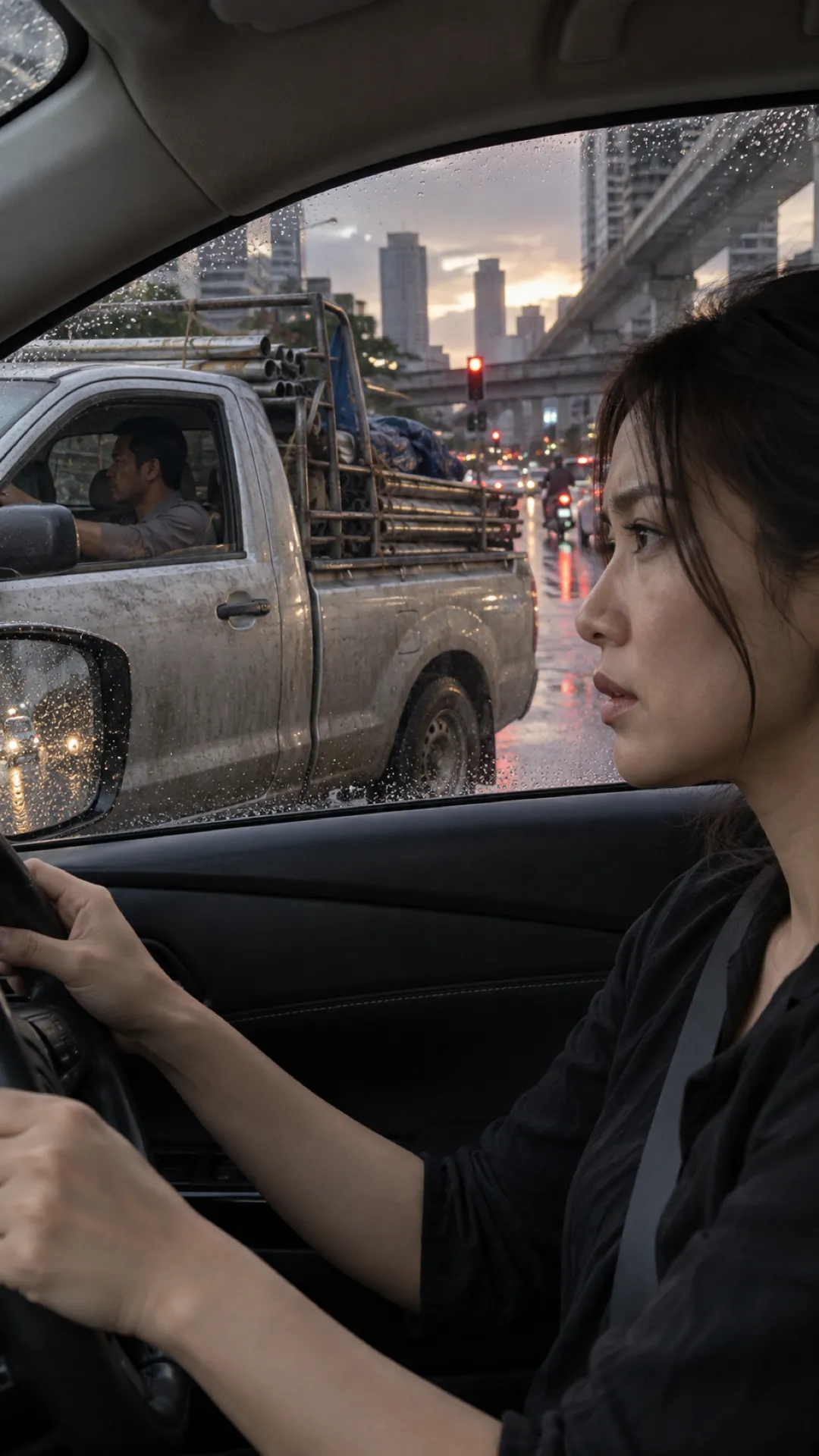
Everyone who drives in Thailand has a theory. Pickups do this. That particular SUV does that. The German saloons do the other. The theories are held with real confidence, exchanged constantly, and are entirely untested.
I’m not going to list them, and not out of squeamishness. Three articles ago I argued that a word which names a behaviour and then assigns it to a demographic is doing two jobs, and only one of them is fair. Setting out a table of which drivers are worst would be that exact move with a badge on it, and in Thailand these particular judgements sort almost perfectly by wealth, which means the sharpest ones land on the people with the least.
The interesting question isn’t whether the theories are right. It’s why everyone has one.
What you cannot know about a Thai driver
Consider what you actually have to go on, sitting at a junction, about the person in the next lane.
Nothing.
Not their licence status. Not whether they have ever been penalised. Not whether they have crashed before, or how often, or how badly. Not whether they are insured beyond the compulsory sticker that article 88 The sticker is not insurance established most people misunderstand. Not one fact about them as a driver.
And until very recently, that was not just a limitation of your position at the junction. It was close to the state of the world.
Article 81 The fine nobody paid established the shape of it. Around 85% of traffic tickets were going unpaid, not through corruption but because the police system and the transport registry were not connected, so an ignored ticket surfaced nowhere and attached to nothing. A driver could accumulate violations for years and arrive at renewal with a clean-looking file.
Article 113 The gun was legal established the other half. A Thai firearms licence and a Thai driving licence share an architecture: the state examines you hardest at the moment of application, and then very little happens. There is no rolling assessment. The record, such as it is, has not been a record anyone consults.
So Thailand has had a driving population of tens of millions about whom, individually, almost nothing was known — including by the state.
Which is why the car has to do the work
Now the finding, and it is not really about cars at all.
People need to predict what the vehicle beside them is about to do. That is not prejudice, it is driving. You are constantly estimating whether the car on your left has seen you, whether the one ahead will stop, whether the one behind is going to try something.
In a system with driver-level accountability, some of that estimation is done for you. Not perfectly, and not consciously, but a population that knows a record exists and follows them behaves measurably differently, and the variance in what any given driver might do narrows. You are predicting people who have been shaped by consequences.
Remove the consequences and the variance widens back out. Now anyone might do anything, and you have no information about which anyone.
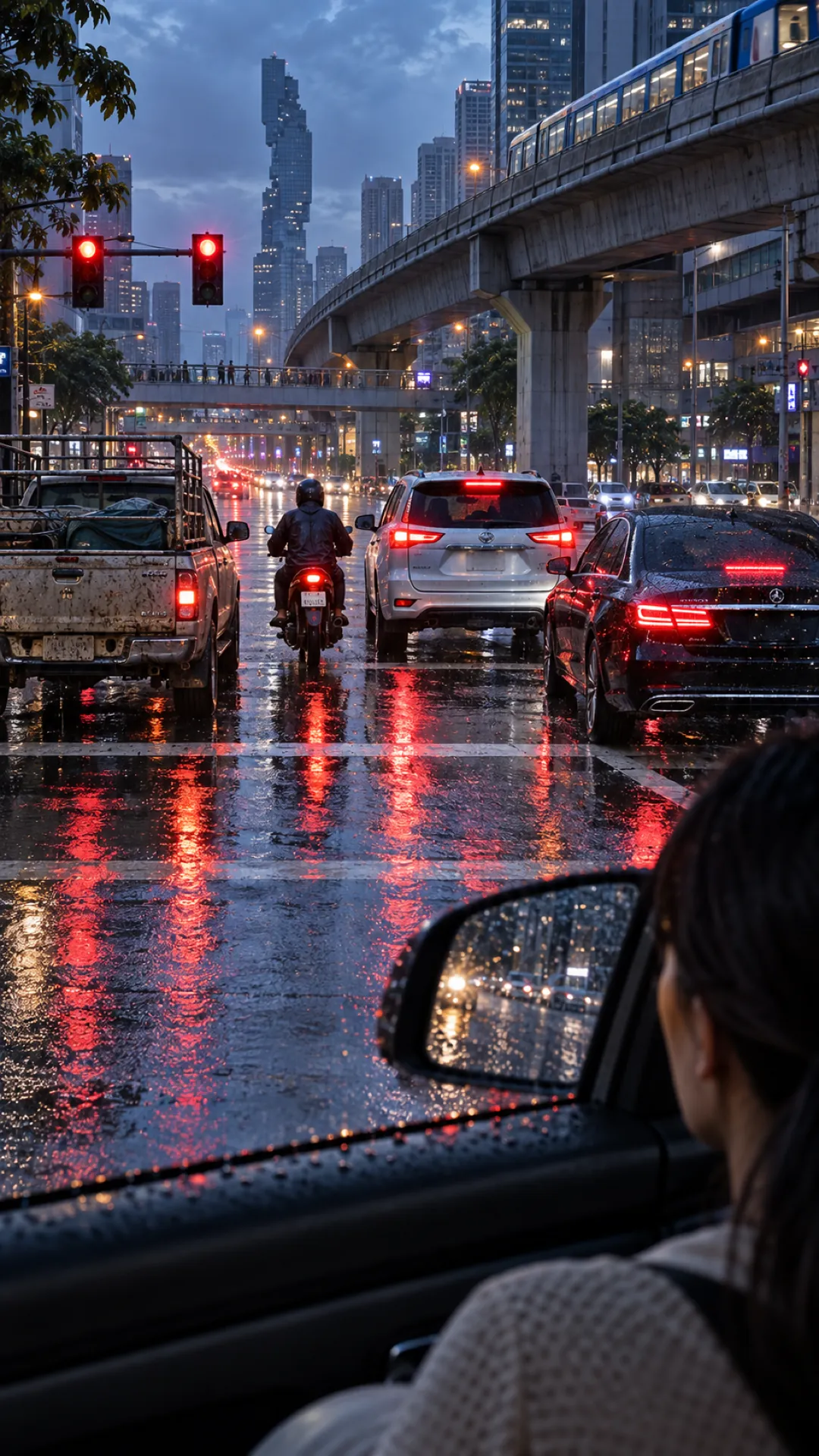
Except one thing. You can see the car.
And so the car gets loaded with everything the missing record would have carried. Not because a vehicle predicts behaviour — but because it is the only variable on the road that is visible, stable, and differs between drivers. People do not reason from vehicles because they are foolish. They reason from vehicles because it is the only data on offer, and a bad signal is what you use when there is no good one.
Which also explains why the stereotypes sort by wealth. They are not really about driving. The only thing a car reliably tells you is roughly what the driver could afford, so a judgement made from a car is a judgement made from price, dressed as a judgement about conduct. The vehicle is a proxy for income and the theory is a proxy for a record. Both substitutions are what you get when the real information is missing.
The one I thought could be checked
An earlier version of this article said there is a case where the data exists. It said pickups are heavily represented in Thai road deaths, that the stereotype explains this with driving, and that a large part of it is really seating.
Then I opened the dataset.
Thailand’s official road-fatality count is the Ministry of Public Health’s three-database integration — death certificates, insurance claims and police records reconciled into one national reference figure. It is published as open data, one row per death. In 2025 it recorded 16,078 people killed, down from 17,477 in 2024.
Here is what that file says about vehicles:
| The deceased was on or in | 2025 |
|---|---|
| A motorcycle | 7,221 |
| No vehicle recorded | 7,102 |
| A car | 916 |
| On foot | 374 |
| A bicycle | 184 |
| A small truck or van | 152 |
| A heavy truck | 71 |
There is no pickup category. The nearest thing is “small truck or van”, which is 0.9% of the total and is not the same class of vehicle. And 44.2% of the country’s road deaths — 7,102 people — have no vehicle recorded at all.
So the claim I was about to make cannot be checked, and neither can the stereotype it was arguing against. Nobody can tell you what share of Thai road deaths involve pickups, because the national reference dataset does not record it. The pickup theory is not wrong. It is unfalsifiable, from the only source that could settle it.
Which is this article’s own argument arriving somewhere I did not expect it to. I began by saying people reason from the car because nothing is knowable about the driver. It turns out the car is barely knowable either. The record that would test the vehicle theory has a hole in it where 44% of the deaths are.
What can be sourced, and it is worth knowing
The Department of Land Transport publishes two figures about riding in an open pickup bed. In one accident in four, a passenger in the bed is thrown out of the vehicle. And in a crash, an open-bed passenger faces around eight times the fatality risk of a belted passenger in the front. The department does not identify the study behind either number, and this article does not present them as more than the department’s own published estimates.
The seating is lawful, and the conditions are the interesting part. Under the Royal Thai Police announcement on seatbelt exemptions of B.E. 2566 (2023): not more than six passengers in the bed, not more than three in the space cab, a speed limit of 60 km/h whenever anyone is riding in the bed, the tailgate closed throughout, no standing anywhere on the vehicle, no sitting on the rim or on the load, and no part of the body outside the vehicle.
That is not a driving style. It is an occupancy arrangement, it is lawful, and the state has already written down that it is dangerous — the conditions are safety conditions, attached to a permission.
Which is the useful version of the point I was originally trying to make. You cannot fix a seating arrangement by disapproving of a category of person. The lever exists, it is already in a regulation, and the argument nobody is having is about whether 60 km/h and a closed tailgate are enough.

What changes now
Both of the gaps described above closed, or began to, in the last few years, which makes this an unusually good moment to write about it.
Thailand has a demerit points system, it has been running since 9 January 2023, and most drivers cannot describe it.
Twelve points, per person — not per licence, and not per vehicle. Hold five categories of licence and you still have twelve. Twenty offences deduct from them, in four bands:
One point. Speeding, no helmet, no seatbelt, phone use, driving on the footway, failing to stop at a pedestrian crossing, failing to give way to an emergency vehicle, alarming careless driving, no or obscured number plate, no tax disc.
Two points. Running a red light, driving the wrong way, and driving while your licence is suspended or revoked.
Three points. Driving while impaired, driving unlike an ordinary driver, hit and run.
Four points. Drink-driving, driving on drugs, unauthorised street racing, driving without regard for the safety of others.
And unpaid tickets deduct points on their own, which is the join between this and article 81 The fine nobody paid: an ignored fine for a parking offence or a road marking now costs the driver points as well as money.
At zero, every licence you hold is suspended for ninety days. Driving during that suspension carries up to three months’ imprisonment, a fine of up to ฿10,000, or both. A third suspension within three years can run longer than ninety days, and a fourth can be considered for revocation.
So three drink-driving offences do exhaust the twelve — and what that produces is a ninety-day suspension, not the loss of a licence.
Two qualifications, because a record that can be reset is not quite a record. Points come back one year after the offence that cost them. And they can be bought back with time rather than money: below six points you may take Department of Land Transport training twice a year, and at zero, training restores the full twelve where simply waiting out the suspension restores only eight.
And from 1 August 2026, unpaid fines attach to the vehicle and block the annual tax disc, because the police and transport databases were finally linked. Article 81 The fine nobody paid covers the mechanism.
Which means that for the first time, there is a driver-level history that exists, accumulates, decays on a published schedule, and has a consequence bolted to it.
If the argument in this piece is right, that should eventually do something to the stereotypes — not because anyone will consult another driver’s record at a junction, but because the population being predicted starts getting shaped by something, and the variance narrows. That is a testable claim and it will take years to test. I’d rather state it and be checkable than not.
And there is a nearer, more useful effect. A driver who knows they are carrying points is a driver about whom something is now true. The theory people currently hold about your car will still be wrong. It will just matter less.
Practically
You can look up your own points, your licence status and your unpaid tickets at ptm.police.go.th or in the Royal Thai Police’s ขับดี app. Do it before your tax renewal, especially if you have moved — article 81 The fine nobody paid has the detail on why an old address is the common failure.
If you carry passengers in a pickup bed, two numbers matter more than anything else here. The Department of Land Transport’s estimate of eight times the fatality risk, and the legal limit of 60 km/h whenever anyone is riding back there. The second is the one you control.
And on the judgements themselves: keep predicting the car, because that is driving and you need to. Just hold the theory loosely, and notice that the confident version of it always seems to be about somebody poorer.
Common misconceptions
“Certain vehicles have worse drivers.” No Thai dataset supports a per-marque behavioural comparison, and this article makes no such claim about any manufacturer’s customers.
“Pickups are dangerous because of how they’re driven.” Nobody can show that from the national record, which has no pickup category and no vehicle recorded for 44% of road deaths. What is published is the Department of Land Transport’s estimate that an open-bed passenger faces around eight times the fatality risk of a belted front-seat passenger, and that in one crash in four a bed passenger is thrown out.
“Thailand has no penalty points.” Twelve per person since January 2023, across twenty offences, with one to four deducted each time and a ninety-day suspension of every licence at zero.
“Points are gone for good once deducted.” They return one year after the offence, and Department of Land Transport training can restore them sooner — twice a year below six points, and in full from zero.
“Nothing happens if you ignore a ticket.” That was substantially true until 1 August 2026. Unpaid fines now attach to the vehicle and block the tax disc.
“These judgements are harmless.” They are a reasonable response to missing information. They also sort by wealth, and the sharpest ones land on the people with the least.
Common questions
- Do certain vehicles really have worse drivers in Thailand?
- No Thai dataset supports comparing driver behaviour by vehicle marque, and this article makes no such claim. The judgements are widespread but untested.
- Why do Thai drivers stereotype by vehicle?
- Because almost nothing else about another driver is visible. Until recently there was little functioning driver-level accountability — most tickets went unpaid and licences were rarely reassessed — so the vehicle became the only stable, visible signal available.
- Are pickups more dangerous in Thailand?
- Nobody can say from the national record. Thailand's official road-fatality dataset has no pickup category and records no vehicle at all for 44% of deaths. What is published is the Department of Land Transport's estimate that riding in an open bed carries around eight times the fatality risk of a belted front seat, and that in one accident in four a bed passenger is ejected. Up to six may lawfully ride there, at up to 60 km/h.
- How does the Thai demerit points system work?
- Every driver has twelve points, not every licence — the total is shared across all licence categories you hold. Twenty offences deduct from it: one point for speeding, no helmet, phone use, no seatbelt, no tax disc and similar; two for a red light, wrong-way driving or driving while suspended; three for hit and run or driving while impaired; four for drink-driving, drugs, racing or driving without regard for others' safety. Unpaid tickets deduct points too. At zero, every licence is suspended for ninety days. Points return one year after the offence, and Department of Land Transport training can restore them sooner.
- What changed on 1 August 2026?
- Unpaid traffic fines now attach to the vehicle and block issuance of the annual tax disc, after police and transport databases were linked.
- Is it legal to ride in the back of a pickup in Thailand?
- Yes, with conditions. Under the Royal Thai Police announcement of B.E. 2566 (2023): up to six in the bed, up to three in the space cab, a 60 km/h limit whenever anyone is riding in the bed, the tailgate closed, no standing anywhere on the vehicle, no sitting on the rim or on the load, and nothing protruding outside. The safety risk is separate from the legality and is considerably higher than sitting belted in front.