What the temple used to do
Thai temples held around ฿410 billion in bank deposits across 39,000 accounts in early 2025, and take an estimated ฿120 billion a year in donations. Fewer than half file financial reports on time.
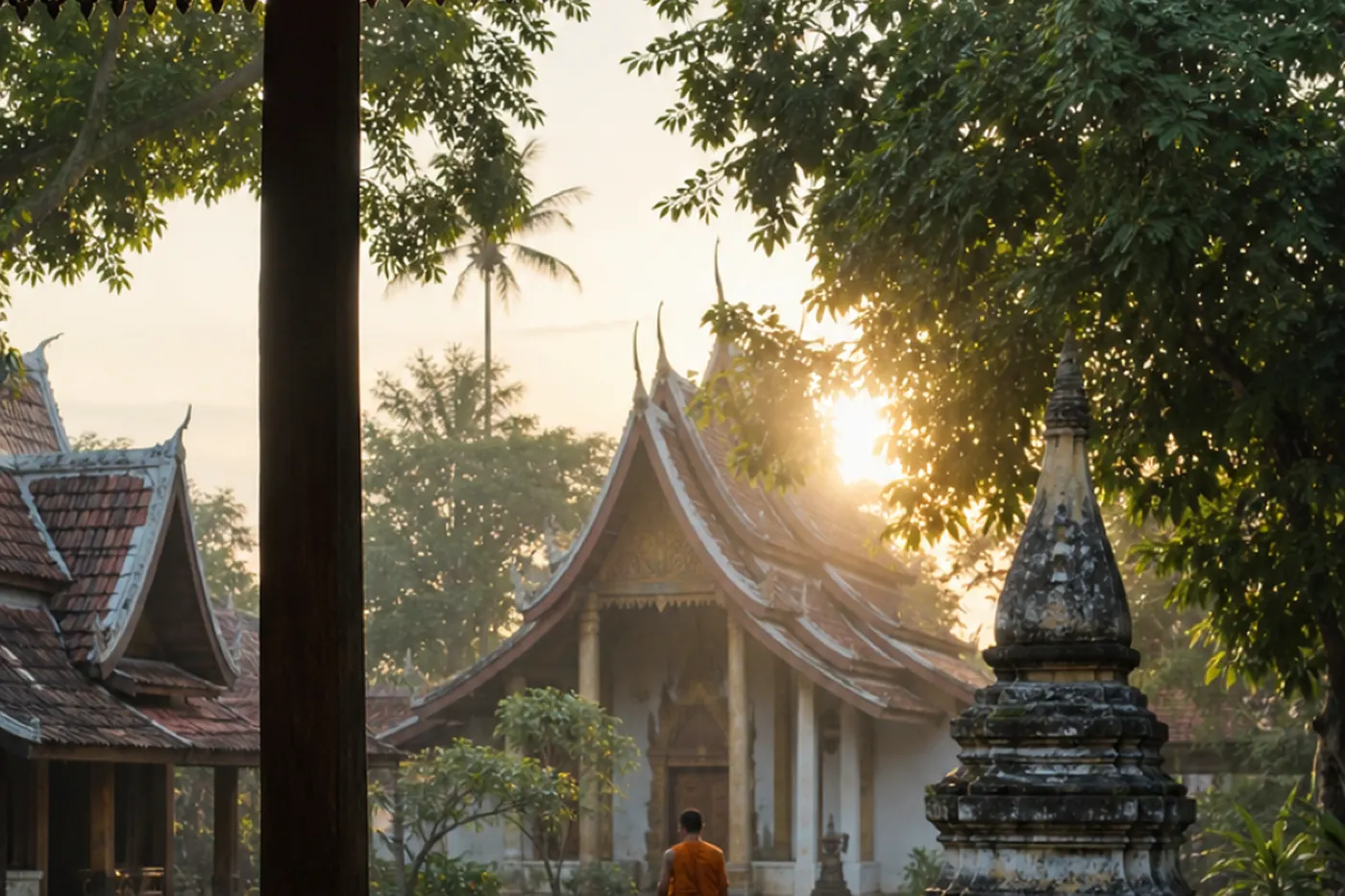
Before Thailand had a state that built things, it had temples.
The วัด was the school. It was the hospital, or the nearest thing to one. It was where orphans went, where travellers slept, where the village stored things it couldn’t keep safe at home, where disputes were settled, where funerals happened, and where a family with no money could send a son to be educated and fed.
It was the welfare state, several centuries before there was a state to have one.
Article 61 The country that outsourced its public space argued that Thailand outsources public functions to private companies because the state didn’t build in those places. The temple got there first, and it wasn’t outsourcing; there was nothing to outsource from.
That history is the only sensible starting point for the numbers, which are extraordinary.
The numbers
Thailand has 44,195 registered Buddhist temples, as of the National Office of Buddhism’s March 2025 count. Roughly 30,000 are the active figure used in financial estimates, with several thousand recorded as deserted — a gap worth holding on to, because it’s part of the story.
Those temples receive somewhere around ฿120 billion a year in donations.
That figure is an estimate and it cannot be anything else, for a reason the next paragraph makes plain: most temples do not file financial reports. There is no audited national total of Thai temple donations, and anyone quoting one — including this article — is quoting a reconstruction.
And they hold approximately ฿410 billion across about 39,000 bank accounts — a figure for the first quarter of 2025, from National Office of Buddhism and Bank of Thailand reporting, up roughly 5.5% on the year before.
That number is deposits, not wealth, and this article previously called it “total funds”. It is what temples and monks hold with banks. It does not include land, buildings, or anything else a temple owns, and Thai temples own a great deal of all three. The real figure for what the institution holds is larger and nobody publishes it.
It is also the one number here that is close to measured rather than estimated, because banks report deposits whether or not a temple files anything.
Four hundred and ten billion baht. Thirty-nine thousand accounts.
Fewer than half of temples submit their financial reports on time, and there is very little public disclosure of what any individual temple holds or spends.
That is not an accusation. It is a description of an accounting system, and I’d note that the strongest calls for reform have come from within the institution itself — the Supreme Patriarch has publicly ordered greater transparency in temple finances, which is not the act of an institution that thinks nothing needs fixing.
The oldest parallel economy
Article 57 Thailand’s parallel economy described Thailand’s informal financial systems (savings circles, funeral societies, gold, family remittances) as arrangements running without contracts, enforced by reputation.
The temple is the oldest one, the largest one, and the one everything else was modelled on.
You put money in a box. There is no receipt, no statement, no audit you can request and no mechanism by which you could ever check what happened to it. The entire transaction rests on trust and on the fact that the abbot lives here and you will see him again — which is, precisely and exactly, article 70’s underground bookmaker and article 57’s savings circle, operating at ฿120 billion a year.
The difference is scale, and scale is where reputational enforcement stops working. A neighbourhood knows if its bookmaker doesn’t pay. Nobody can know what 39,000 accounts are doing.
What merit is, economically
I want to handle this carefully, because there’s a reductive version of this paragraph that I don’t believe and won’t write.
ทำบุญ — making merit — is a religious practice with religious meaning, and treating it as a financial product misses what it is to the person doing it. I’m not going to pretend the meaning is a cover story for the mechanism.
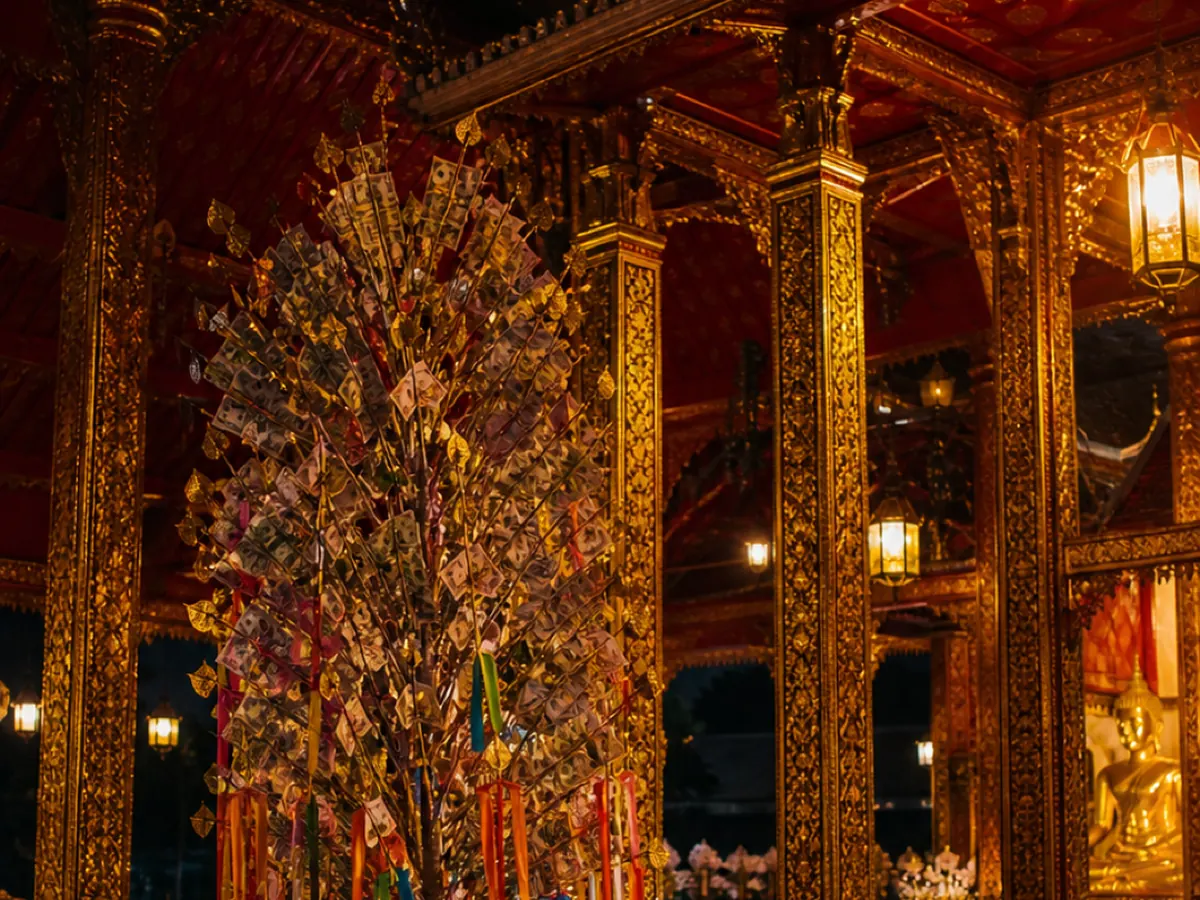
But the mechanism is also real, and it has a shape worth naming. Merit is an investment with a long horizon: you contribute now, in small amounts, for a benefit that arrives later, and it is available in denominations of twenty baht.
Set that against article 38’s state pension of ฿600 a month, and article 57’s finding that formal financial products barely reach a large share of the population.
In a country where most long-horizon financial products are out of reach, merit is the one that isn’t. You do not need an income statement, a credit history, a bank branch or a minimum balance. You need twenty baht and a temple, and there are forty-four thousand temples.
That is not the reason people make merit. It is, however, part of why the practice has been so resilient in a country that has not otherwise provided its poorest citizens with anything to invest in.

The decline nobody frames correctly
Here’s the part I find genuinely interesting, and it runs against the way this is usually reported.
The number of Buddhist monks in Thailand has roughly halved over thirty years — figures for recent years run between about 257,000 and 300,000 depending on source and definition. Thousands of temples are recorded as deserted.
This is normally written as a story of moral decline, and the scandals get cited as the cause.
I think that’s largely wrong, and the actual explanation is in the research and is much less dramatic.
Boys used to ordain to get an education. The temple was where a poor family could send a son to be taught and fed. Thailand now provides twelve years of free public schooling, and far more children attend secular schools.
And short-term ordination has shortened — what was once three months during Buddhist Lent is now commonly seven to fifteen days.
So the decline in ordinations tracks something that is, on its own terms, a success. The temple lost its role as the education system because the state finally built an education system. The same happened, more slowly, with healthcare, with welfare, with dispute resolution.
The functions left, one by one, as the state took them over.
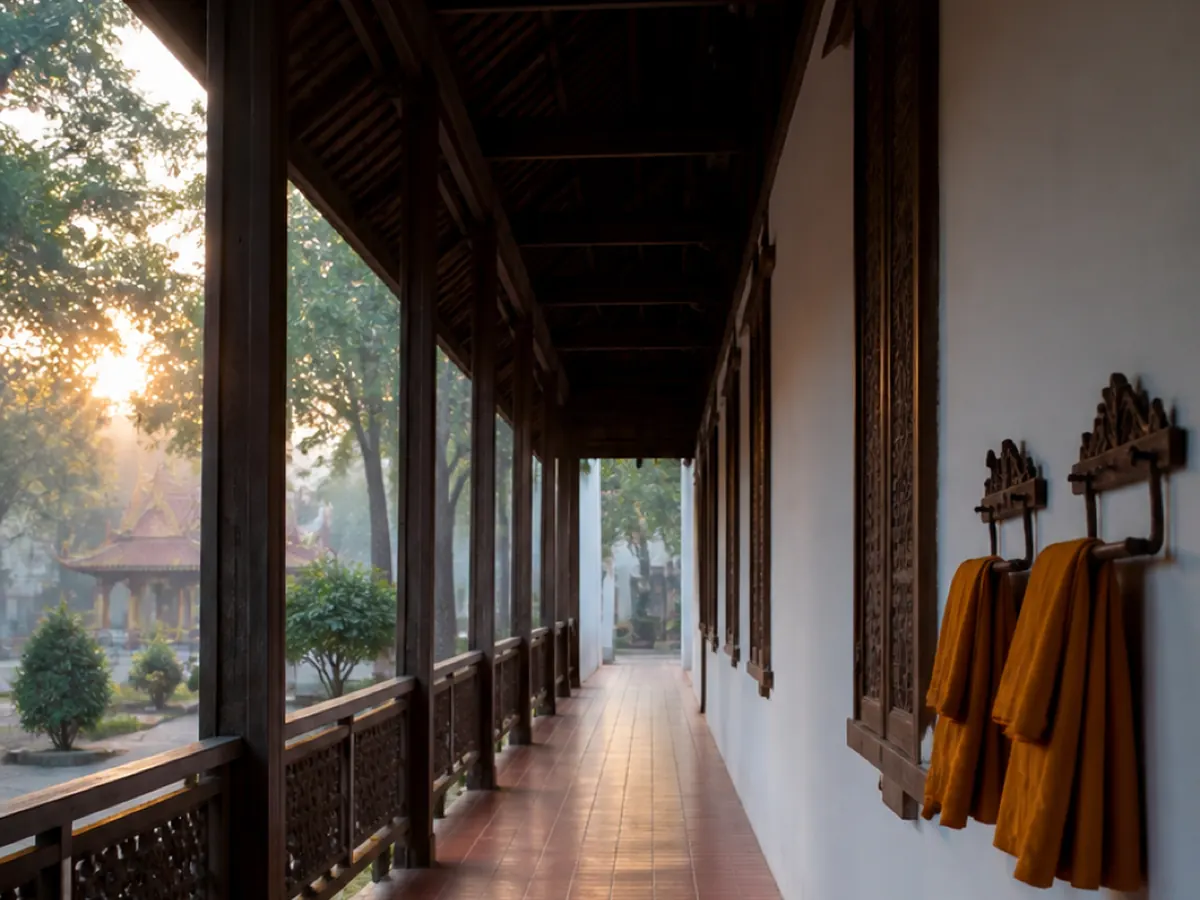
And the money stayed
Which is the structural problem, stated as plainly as I can manage without making an allegation:
An institution that once performed most of a country’s social functions now performs far fewer of them, receives around ฿120 billion a year, holds around ฿410 billion, and files financial reports late more often than not.
Every part of that sentence is a matter of public record. The problem it describes is a governance problem, not a moral one, and it is a predictable outcome for any institution whose income is disconnected from its outputs and whose accounts nobody reads.
Article 61 The country that outsourced its public space asked what happens when private bodies deliver public functions with no accountability route. This is the same question, asked of an institution nine centuries older, and with the additional difficulty that reforming it requires the reformers to be careful in ways that reforming a convenience store chain does not.
Which is, I suspect, exactly why it has been deferred, and article 76’s four-year institutional horizon is not going to help.
What I’d actually want
Not less merit-making, which is not mine to have an opinion about and is doing no harm.
Standard accounts, filed on time, published. That’s it. It is what every other institution handling public money is expected to do, it is what the institution’s own leadership has called for, and it protects the overwhelming majority of temples that are running honestly on very little.
The temples with nothing to hide are the ones currently paying the reputational cost of a system that lets anything be hidden. That’s the argument I’d make to anyone who thinks scrutiny is disrespectful — it is the opposite, and the institution’s own senior figures have said so more clearly than I can.
Common misconceptions
“Temples are funded by the state.” They receive some state support, but the overwhelming majority of temple income is donations.
“Monks are declining because of scandals.” The research points primarily at free public education removing the main historical reason for ordination, and at short-term ordination shortening.
“Temple money is unaccounted for because of corruption.” The reporting system is weak and compliance is poor. Those are the documented facts; conclusions beyond them require evidence about specific cases.
“Making merit is just donating.” It’s a religious practice with its own meaning. It also happens to be the only long-horizon investment available to a great many people, and both things are true.
“Thailand is becoming less Buddhist.” Practice remains near-universal. It’s ordination, the institutional part, that has fallen.
Common questions
- How much money do Thai temples receive?
- Estimates put annual donations around ฿120 billion — an estimate rather than an audited total, because most temples do not file reports. Bank deposits were roughly ฿410 billion across about 39,000 accounts in the first quarter of 2025. That figure is deposits only and excludes land and buildings.
- Are Thai temple finances audited?
- Reporting requirements exist but compliance is weak — fewer than half of temples file on time, and there is little public disclosure.
- How many temples are there in Thailand?
- 44,195 registered as of March 2025, with roughly 30,000 typically treated as active and several thousand recorded as deserted.
- Why are there fewer monks than there used to be?
- Primarily because free public education removed the historical reason many boys ordained, and because short-term ordination has shortened from around three months to one or two weeks.
- What is tam bun?
- ทำบุญ — making merit, through donation and other acts, in the expectation of benefit in this life or the next.
- Is Buddhism declining in Thailand?
- Practice remains near-universal. Ordination and the monastic institution have declined substantially.