Nobody's dog
Thailand's soi dogs aren't strays. They belong to the street — fed by several households, owned by none. And the temple is still the only institution that takes them in.
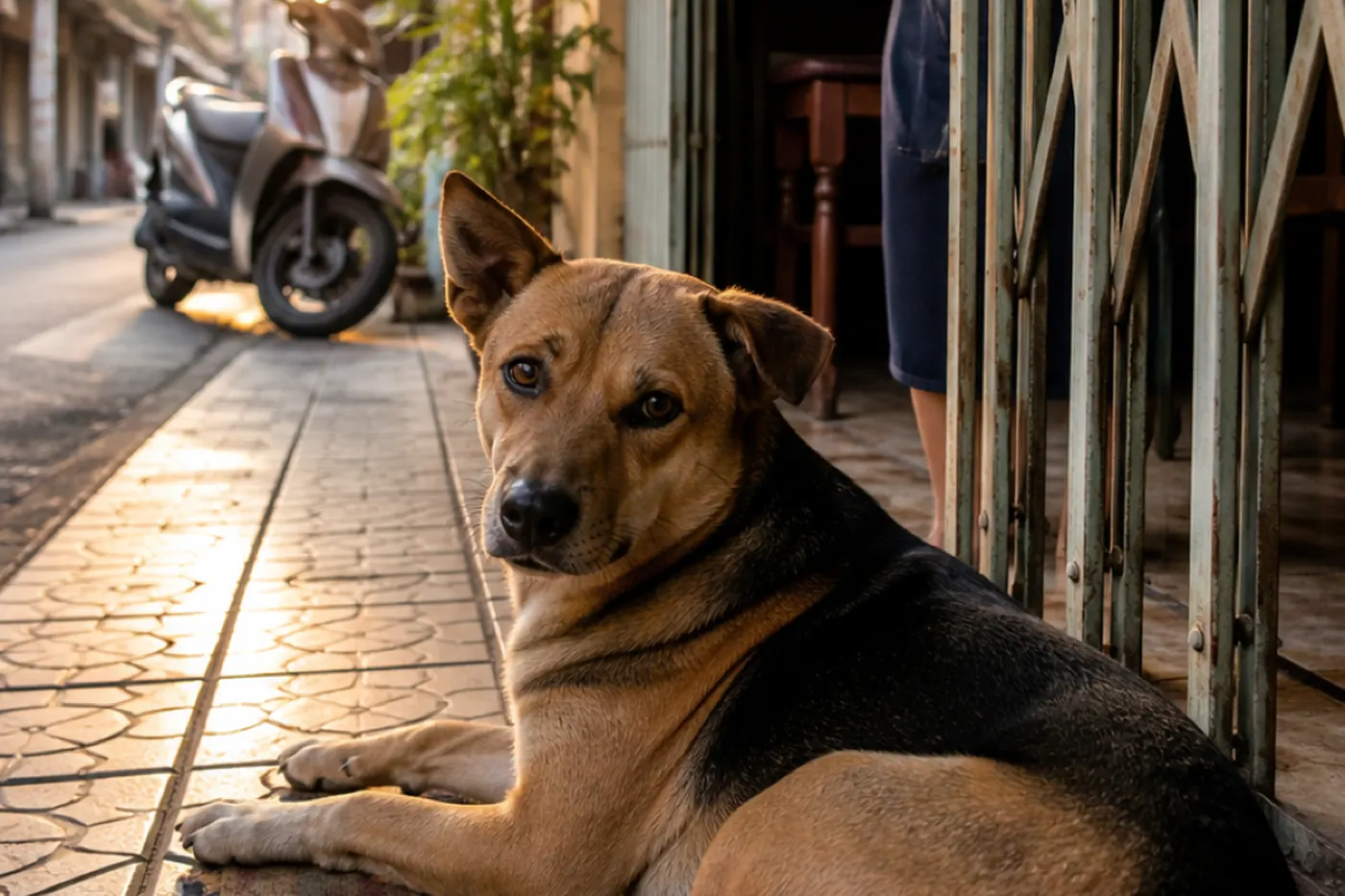
There is a dog at the end of my soi. She has lived there for years. Four or five households feed her, at least three have given her different names, and if you asked any of them whether she was their dog they would say no, and then they would tell you what she likes to eat.
She is not a stray. She has a territory, a routine, a group of people responsible for her, and a place she sleeps that everyone respects.
She is nobody’s dog, which in Thailand is a category and not an absence of one.
Why the numbers don’t add up
Estimates of Thailand’s street dog population run to 10 to 12 million. The total dog population is estimated around 12.8 million.
Look at those two figures together and they barely leave room for pets.
They don’t reconcile because the categories are wrong. A dog fed by four families, sleeping outside a shop that tolerates her, vaccinated once by a mobile clinic and belonging to no household on any register, is neither an owned dog nor a stray. She is a third thing, and the counting frameworks — which were built elsewhere, for places where a dog is either property or a problem — have no box for her.
Thailand’s dogs are held the way article 57’s savings circles are held: collectively, informally, by people who accept a responsibility they never formally took on. It works for the same reason and it fails in the same places.
What it works at, and what it doesn’t
It works at not killing them, which is not a small thing and is the whole moral architecture of the arrangement.
In a great many countries, “solving” a street dog population has historically meant culling it. That has never been broadly acceptable here, and the Buddhist objection to taking life is the reason. So Thailand ended up with coexistence as policy — the dogs stay, people feed them, and the population is managed slowly or not at all.
Thailand’s dog policy is slow because it refuses to kill. That is not a failure of the policy. It is the policy, and I’d rather live in the country that made that choice.
What it fails at is disease, and that’s where the honesty has to come in.
Rabies, plainly
Only around 20% of the free-roaming dog population is estimated to be vaccinated or sterilised.
The widely cited threshold for interrupting rabies transmission in a dog population is around 70% vaccination coverage. At 20%, Thailand is a long way from it.
The surveillance figures: 305 confirmed animal rabies cases in 2024 — 4.98% of 6,130 animals tested — with 97 positives from 1,678 tested in the first quarter of 2025. Around 90% of cases are dogs and 10% cats.
Human deaths are in single figures annually. Eight nationwide between 2024 and the first quarter of 2025, spread across eight different provinces, and Thailand’s first fatality of 2026 was a man in Rayong.
Every one of those deaths was preventable, and that is the whole point of including them.
Thailand has adopted a national target of eliminating human rabies by 2030, in line with the global Zero by 30 initiative. It is achievable and it is a long way off at current coverage.
If you are bitten
This section exists because some readers will arrive here having just been bitten, and this is the part that matters.
Wash the wound immediately with soap and running water, for a good fifteen minutes. This alone substantially reduces risk and it is the single most useful thing you can do in the first minute.
Then go and get post-exposure treatment. The same day. Not tomorrow, not if it looks infected. Thai hospitals and clinics handle this constantly, it is inexpensive, and it is routine.
Post-exposure prophylaxis is highly effective when given promptly. Rabies, once symptoms appear, is not treatable. That is the entire reason this is worth being firm about.
A small bite counts. A scratch counts. A puppy counts — Thailand’s first 2026 death followed a bite that was not acted on.
Do not wait to see what happens. There is nothing to see until it is far too late.
(I am not a doctor and this is general information, not medical advice. Go to a hospital.)
What actually works
The encouraging part, and it’s genuinely encouraging.
Catch, Neuter, Vaccinate, Return is the method, and it is being done at real scale. Over 400,000 dogs were sterilised and vaccinated across Greater Bangkok between 2016 and 2023. The Soi Dog Foundation reports neutering and vaccinating more than 20,000 animals a month, and passed a millionth animal.
And Phuket has reduced its street dog population by over 90% through sustained programme work.
That last figure is the important one. It demonstrates that this is not a permanent condition or a cultural inevitability. It is a resourcing question with a known answer, and one province has already done it.

The temple, still
Article 79 What the temple used to do argued that the Thai temple was the country’s original welfare state — school, hospital, orphanage, bank, court — and that the state has since taken over almost all of those functions, which is why ordinations halved.
Almost all.
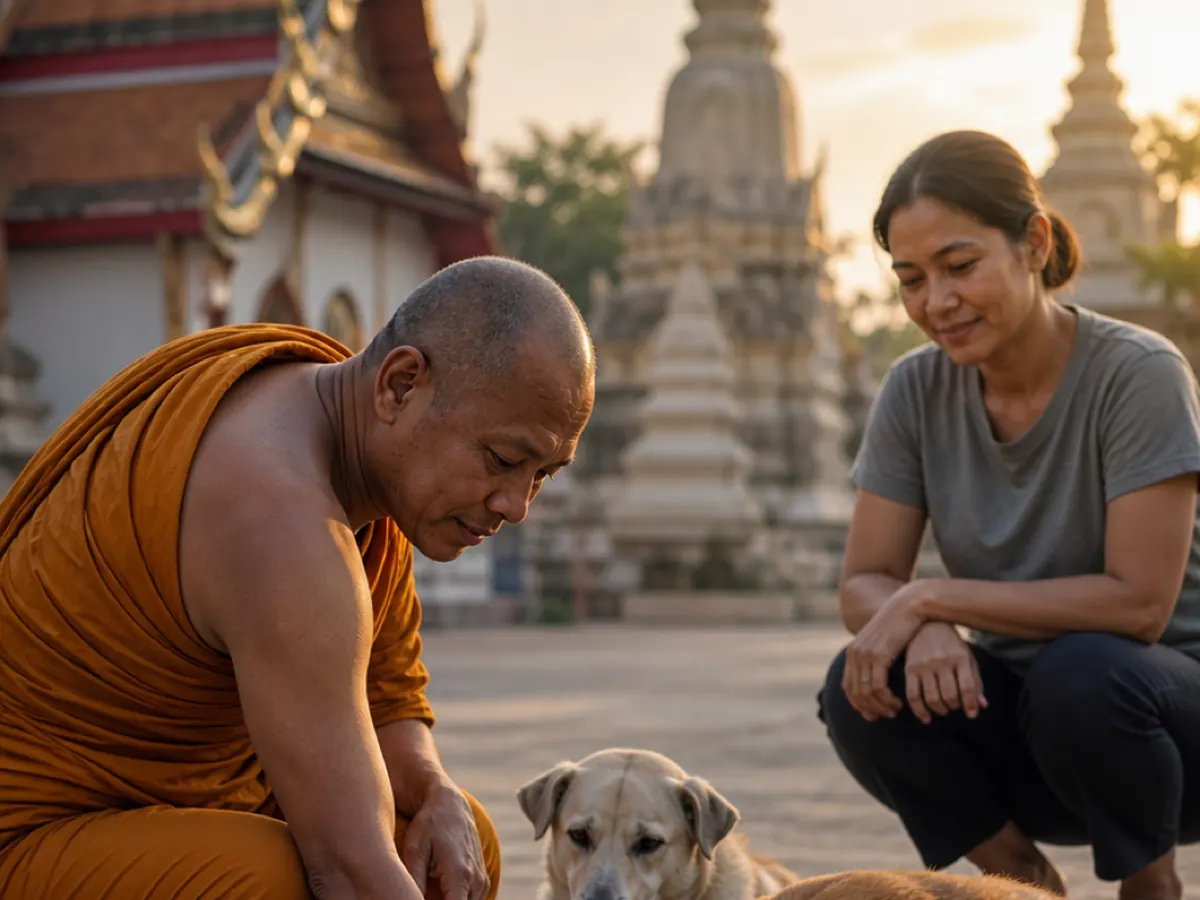
The one function nobody took over is this one. Unwanted dogs are left at temples. Monks feed them. Animal welfare organisations run vaccination and sterilisation programmes through temples, and have trained monks in animal handling, because the temple is where the animals are.
Nine centuries of institutional retreat, and the oldest welfare institution in Thailand is still holding the last function that nobody else wanted.
I find that quietly moving and I don’t think it’s sentimental to say so. The temple takes what the state won’t, which is exactly what it has always done, and the fact that the remaining category is dogs says as much about the state as about the temple.

Living alongside them
Don’t run, and don’t stare. Running triggers a chase. Sustained eye contact reads as a challenge.
Walk past at a steady pace. Most soi dogs are entirely uninterested in you and are defending a small territory rather than looking for trouble.
Be more careful at night and near puppies. Both change the calculation.
Don’t feed the dog outside your building unless you’re prepared to keep doing it. You are joining a rota that other people are already keeping, and dropping out has consequences for the animal.
And if you want to help, the sterilisation programmes are where money does the most work. Not feeding. The maths of CNVR is unambiguous.
Common misconceptions
“Thai street dogs are strays.” Most are community dogs — fed by several households, owned by none, with a territory and a place in the street.
“Nobody cares about them.” They are fed daily by people with no obligation to do so, and culling has never been broadly acceptable.
“Thailand should just remove them.” That has been rejected on moral grounds, which is why the slower method exists. Phuket shows the slower method works.
“Rabies isn’t really a risk.” Human deaths are in single figures annually, but around 305 animal cases were confirmed in 2024 and roughly 20% vaccination coverage is well short of the ~70% needed. Any bite needs same-day treatment.
“You can’t do anything about a bite after the fact.” Post-exposure treatment is highly effective if given promptly. That is precisely why prompt matters.
Common questions
- Are Thai street dogs dangerous?
- Most are community dogs defending a small territory and are uninterested in passers-by. Walk steadily, avoid eye contact, take more care at night and near puppies.
- How many street dogs are there in Thailand?
- Estimates run to 10–12 million, though the figures vary because most are community dogs rather than strays and are difficult to categorise.
- Is rabies a real risk in Thailand?
- Human deaths are in single figures annually, but 305 animal cases were confirmed in 2024 and vaccination coverage is around 20% against the ~70% generally needed. Any bite should be treated the same day.
- What should I do if a dog bites me?
- Wash the wound with soap and running water for about fifteen minutes, then go to a hospital or clinic the same day for post-exposure treatment. Do not wait.
- Why doesn't Thailand remove the dogs?
- Culling has not been broadly acceptable, largely on Buddhist grounds. Catch-Neuter-Vaccinate-Return is the accepted method, and Phuket has cut its population by over 90% using it.
- Why are there so many dogs at temples?
- Unwanted animals are left there and monks feed them. Temples remain the default refuge, and vaccination programmes are often run through them.