Red or black
Thailand allocates two years of a young man's life by drawing a card from a jar. The lottery is fair. Who is standing in the room is not.
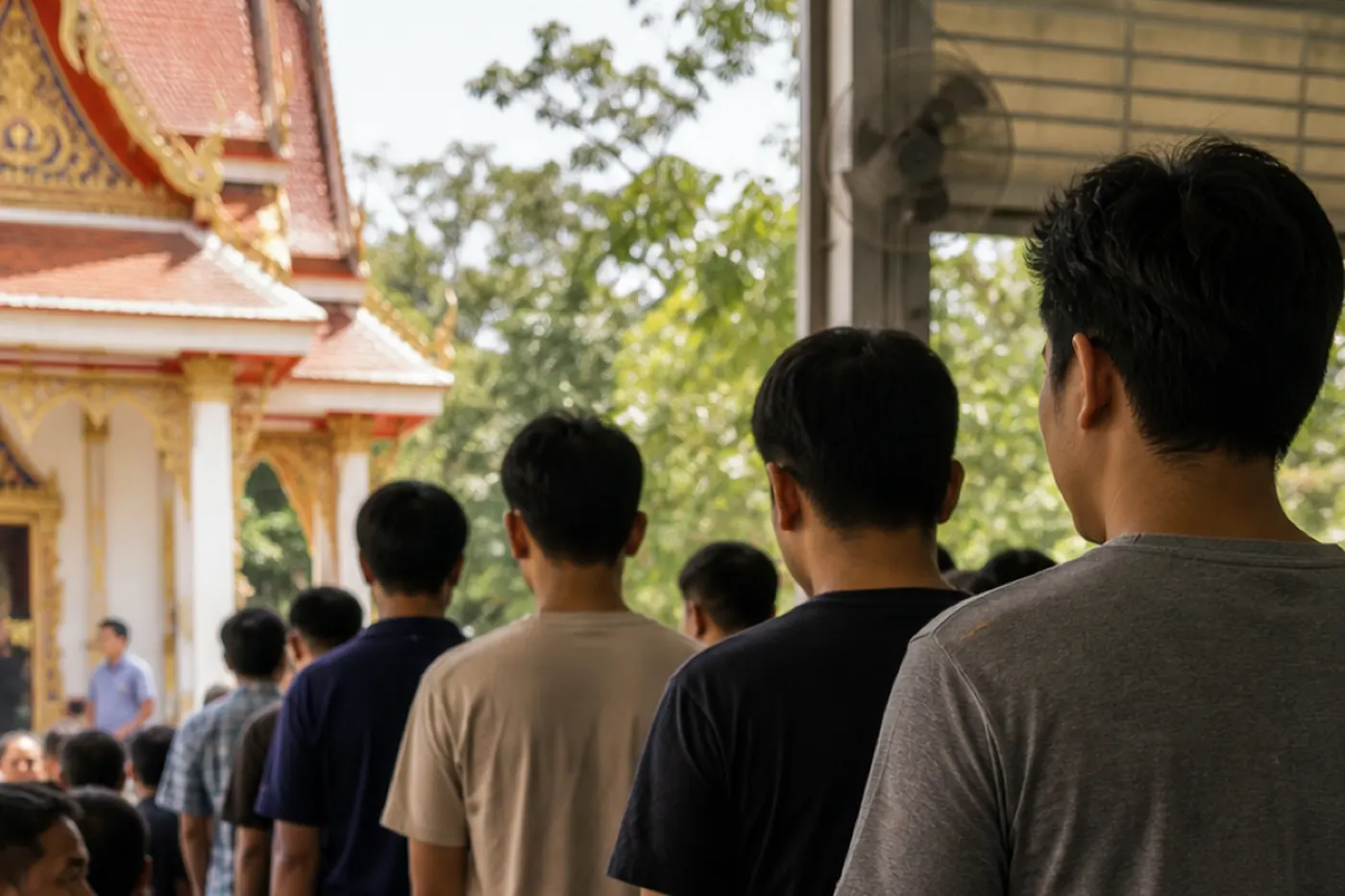
Every April, in halls and temple grounds across Thailand, young men queue to reach into a container and pull out a card.
Black, and they go home. Red, and they serve two years.
That is not a metaphor for how conscription works here. That is how conscription works here. The allocation of two years of a citizen’s life is performed by a draw, in public, with families watching, and it is filmed, and men faint, and the footage goes around the world every spring.
The 2026 selection ran from 1 to 12 April, pausing on the 6th for Chakri Day. Men born in 2005 were called, along with those born between 1997 and 2004 whose selection had never been completed.
The terms
Worth having these straight, because the differences are enormous.
Drawn red: two years. Drawn red with a university degree: one year. Volunteered: six months.
Those are three very different outcomes attached to the same obligation, and the gaps between them are where all the interesting behaviour happens.
The arithmetic nobody has done
Reporting from one draw location this April described a fairly typical scene: 68 eligible men present, 15 of whom had already volunteered, leaving 21 places to be filled by lottery.
Depending on whether the volunteers are counted inside that 68, the reporting isn’t explicit and I won’t pretend otherwise, the odds of drawing red were somewhere between roughly 31% and 40%.
That is not a remote risk. That is somewhere between a one-in-three and a two-in-five chance of losing two years.
Now do what a twenty-year-old standing in that room is doing.
Volunteering costs six months, with certainty. The draw costs, on expectation, around 0.4 × 24 months, call it nine and a half months, with enormous variance either side.
Volunteering is the better bet. It costs less in expectation and it removes the variance entirely, which for someone with a job, a course or a family to support is worth more than the expectation difference.
And nearly 30,000 men volunteered nationwide this year — up almost 50% on 2024.
That is not a surge of patriotism. That is a population doing arithmetic, and doing it correctly.

The lottery is fair. The room isn’t.
Here is the part that matters, and it is the reason this belongs on this site rather than in the annual wire story.
The draw itself is genuinely random. Who is standing in the hall is not.
There is an exemption route, and it runs through school.
ROTC — ร.ด., Ror Dor — is school-based military training, available from around Grade 9, open to students aged 15 to 22. Complete three years and you receive draft exemption papers. You never attend a draw.
And students can defer, postponing selection while in education, up to the age of 27.
So assemble the picture. The young men in that hall, holding a one-in-three chance of losing two years, are overwhelmingly the ones who left education earliest. They didn’t do three years of ROTC because they weren’t in school for three years. They couldn’t defer because they weren’t studying. And if they are drawn, they serve two years rather than one, because they don’t have the degree that halves it.
Every single mechanism that reduces exposure is attached to staying in education.
Article 64 The toll road to university argued that Thai education is a series of tolls, each sorting by ability to pay — the ฿61,000 admission cost, article 41’s ฿95 billion international school sector, the tutoring industry underneath it.
This is another toll on the same road, and the price is two years.
I want to be precise about the claim: I am not saying the system was designed to do this. ROTC exists for reserve-building reasons and educational deferment is entirely standard internationally. I am saying that the combined effect is a lottery held among the people with the fewest alternatives, and that this is a description rather than an accusation.
Where it’s going
Conscription in Thailand may be ending, slowly.
A phase-out was announced in September 2023, beginning April 2024 and intended to complete by 2027. The direction has been towards voluntary enlistment.
And the volunteer numbers suggest it might end itself before the legislation gets there. Thirty thousand volunteers, up 50% in two years, against fixed manpower requirements — if volunteering keeps rising, the lottery becomes vestigial arithmetic long before anyone abolishes it.
Whether that is what happens is genuinely unresolved, and article 76’s four-year institutional horizon is the reason I’d be cautious about predicting it. A policy announced in 2023 to complete in 2027 is a policy that has to survive things Thai policies have historically not survived.

For dual-nationality families
Because this is the group that actually needs the information and the English-language guidance is thin.
Thai nationality carries the obligation regardless of where a son was raised, and it is triggered by the Thai registration rather than by residence.
ROTC is the clean route if the timing works — three years from around Grade 9, and several Thai and international schools run it.
Deferment while studying is available up to 27, but it is a delay and not a resolution.
And the paperwork matters more than anything else. Failure to report is itself an offence, and the most common problem families run into is administrative rather than the draw. Get advice from someone who does this professionally — this article is an explanation of a system, not guidance for a specific case.

Common misconceptions
“All Thai men do military service.” Most do not. ROTC exempts a large share, and among those who attend the draw, many draw black.
“It’s a two-year commitment.” Two years if drawn, one if drawn with a degree, six months if volunteering.
“The lottery is rigged.” The draw itself is public and, by all accounts, straightforwardly random. The selection of who has to attend it is where the inequality sits.
“Volunteering is patriotic naivety.” Volunteering is the mathematically better option at typical odds, and the 50% rise in volunteers tracks people realising it.
“Conscription has been abolished.” A phase-out was announced in 2023 targeting 2027. It has not been completed.
Common questions
- How does the Thai military draft work?
- Eligible men attend a selection each April and, if the quota isn't filled by volunteers, draw a card. Red means conscription, black means exemption.
- How long is Thai military service?
- Two years if conscripted, one year for university graduates, six months for volunteers.
- How can you avoid the draft?
- Completing three years of ROTC (ร.ด.) training from around Grade 9 provides exemption. Students may also defer selection while studying, up to age 27.
- What are the odds of being drawn?
- It varies entirely by location and quota. At one reported 2026 location the chance was somewhere between roughly 31% and 40%.
- Why do so many volunteer?
- Six months certain is a better outcome than a one-in-three chance of two years, and volunteer numbers rose almost 50% between 2024 and 2026.
- Is conscription being abolished?
- A phase-out was announced in 2023 with a 2027 target. It has not been completed.