The last fifty metres
Bangkok's water authority says its tap water meets WHO drinking standards. It does, at the plant. What happens after that is why the whole country buys water.
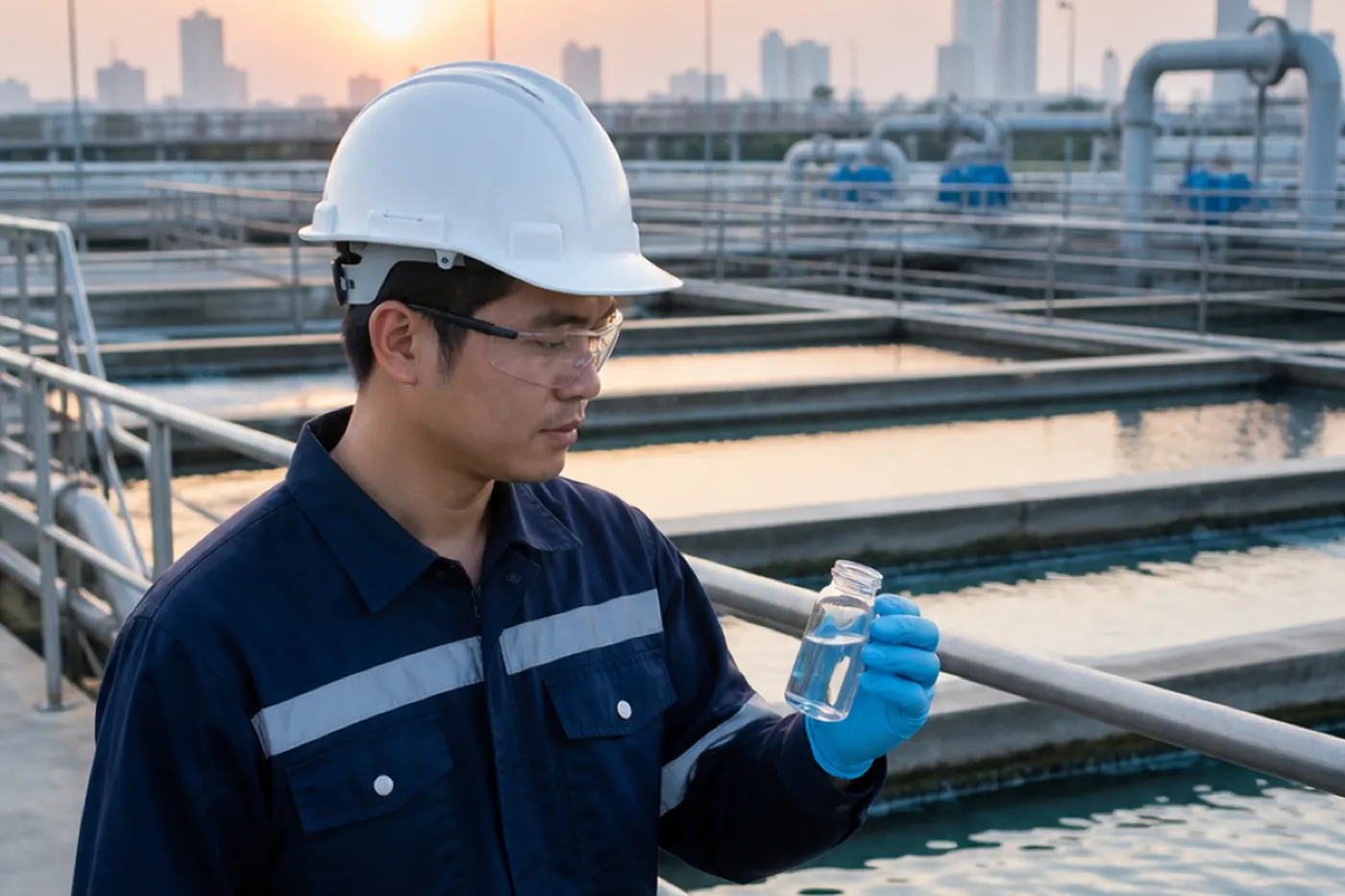
The Metropolitan Waterworks Authority states that its tap water meets World Health Organization criteria for drinking water and is safe to drink throughout its service area. That’s not a tourist board line — it’s in the MWA’s own consumer report, backed by a distribution monitoring programme running since 2001.
Essentially nobody in Bangkok drinks it.
Including me. Including every Thai person I know. Including, I would bet, a good number of people who work for the MWA.
And the interesting thing is that everyone in this arrangement is being completely reasonable.
Where the water actually fails
The raw water comes from the Chao Phraya and the Mae Klong dam, travels down the Khlong Prapa to treatment plants, and is processed to a standard the utility certifies against WHO guidelines.
That water is fine. It is fine right up to the property boundary.
Then it enters the pipes of your building, some of which are old, and in most Bangkok buildings it goes into a storage tank (usually on the roof, sometimes underground) where it sits before being pumped to your tap.
That tank is nobody’s responsibility but the building’s. There is no schedule anyone enforces on it, no test result posted in the lobby, and in a great many buildings no clear answer to when it was last cleaned. Ask your juristic person when the tank was last serviced and watch what happens.
So the utility’s statement is true and useless at the same time. The water was drinkable when it stopped being the utility’s problem. What comes out of your tap has been through fifty metres of infrastructure that nobody certifies.
A true statement you can’t act on
I think this is the part worth extracting, because it goes well beyond water.
The MWA is telling the truth and nobody believes it. That looks like a public trust failure and it isn’t. It’s a verifiability failure.
The claim is accurate about the water at the point of supply and unverifiable about the water at your tap, and the reader has no way to test the difference. A true statement you cannot act on behaves exactly like a false one.
Which means the fix isn’t a public information campaign. You cannot persuade people out of a rational position. The fix is either certifying building plumbing or accepting that the drinking water system will remain private, which is what has happened.

What filled the gap
Article 61 The country that outsourced its public space argued that private provision appears where the state didn’t build. Here the state did build, and built well, and the gap opened inside the property line, which is a version of the pattern I hadn’t seen before.
And what filled it is enormous and invisible, exactly like the ice in article 63 The hole in the ice.
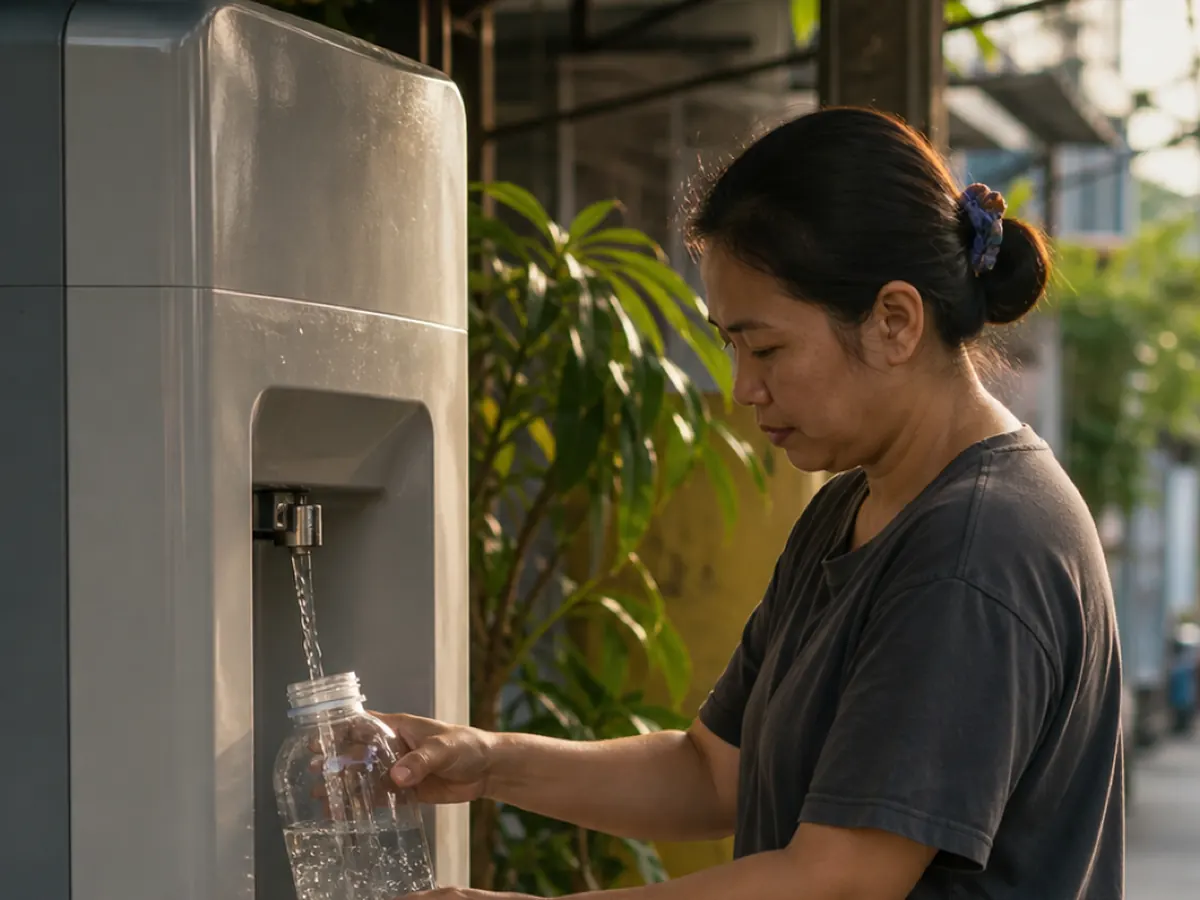
The refill vending machine. Coin-operated, in essentially every neighbourhood, from about ฿1 a refill. You bring the bottle.
The delivered barrel. Twenty litres, around ฿10, with roughly a ฿100 deposit on the container, brought to your door. The reusable dispenser bottle costs ฿200–300 once, from any Makro or hardware shop.
And bottled water everywhere — 350ml for about ฿4, 600ml for about ฿6.
Now do the arithmetic, because this is the bit that costs foreigners real money.
Twenty litres for ฿10 is ฿0.50 a litre. A 600ml bottle at ฿6 is ฿10 a litre.
The small bottle costs about twenty times more per litre than the barrel.
That is the entire practical payload of this article. Thai households worked this out immediately and use the barrel. Foreigners buy 600ml bottles from 7-Eleven for years because nobody ever mentions the alternative, and the delivery network that would solve it operates almost entirely in Thai.
The invisible utility, again
The barrel and refill network is the same shape as the ice industry, and the same shape as the wholesale markets, and the same shape as the win riders:
A fragmented private industry, running at enormous volume on tiny margins, performing a public health function, delivered daily, and never once described as infrastructure.
In a tropical country, safe drinking water is not a convenience. It is the most basic public health provision there is. Thailand produces it publicly to WHO standard and then distributes the final leg of it through coin machines and men on motorbikes, and the arrangement works well enough that nobody has ever thought to call it an arrangement.
There is also a cost nobody prices: a country of seventy-one million people drinking from plastic because of plumbing. The bottles are not a preference. They are a workaround for a maintenance problem, and the environmental bill is being paid for something that is, in principle, already solved at the treatment plant.
What to actually do
Get a barrel on delivery. Almost every soi has a supplier and most buildings already have one calling. Ask the security guard — they’ll know, and they’ll know the price.
Or use the refill machines, which are cheaper still if you don’t mind carrying it.
A filter is worth it if you cook. You’ll be using tap water for rice and washing regardless, and article 63’s ice logic applies — most of the risk is at the margins rather than everywhere.
Ask about the tank when you view a flat. When it was last cleaned, and who’s responsible. The answer, and the speed of the answer, tells you a lot about the building — and it’s a question almost no tenant asks.
And I am not telling you to drink from the tap. The MWA’s position is what it is; what happens between the meter and your kitchen is unknown and unaudited, and the barrel costs fifty satang a litre. There is no reason to take the risk when the alternative is that cheap.
Common misconceptions
“Thai tap water is untreated.” It’s treated to a standard the utility certifies against WHO guidelines. The uncertainty is in building plumbing and storage.
“The government says it’s unsafe.” The water authority says the opposite. The gap is between its pipes and your tap.
“Bottled water is cheap here.” Per litre it’s about twenty times the cost of a delivered barrel.
“Only foreigners get ill from the water.” Thais don’t drink it either. This isn’t a stomach-strength thing.
“You need an expensive filter.” A ฿10 barrel solves drinking. A filter is for cooking and convenience.
Common questions
- Can you drink tap water in Bangkok?
- The water authority states its supply meets WHO drinking standards. The uncertainty is in building pipes and storage tanks, which aren't audited, so the standard practice — including among Thais — is not to.
- Why doesn't anyone drink it if it's certified?
- Because the certification covers the water at supply, not after it passes through a building's plumbing and rooftop tank. It's a verifiability problem rather than a quality one.
- What's the cheapest drinking water in Thailand?
- Refill vending machines from around ฿1, or delivered 20-litre barrels at around ฿10 — roughly ฿0.50 per litre.
- How much is bottled water in Thailand?
- About ฿4 for 350ml and ฿6 for 600ml, which works out near ฿10 per litre — around twenty times the barrel price.
- How do I get water delivered?
- Almost every soi has a supplier. Ask your building's security guard; they will know who calls and what it costs.
- Should I get a filter?
- Useful for cooking and convenience. For drinking, a delivered barrel is cheaper and simpler.