The phone is the confrontation
Somebody on the BTS did say something, and it cost her. Then the phone came out, and within days a company in another country had apologised. That order of events is not an accident.

On 24 July 2026, on a Silom line train, a group of visiting teenagers were being loud.
Somebody asked them to stop.
I want to sit on that sentence for a moment, because everything in this archive says it is the hard part. A Thai passenger, in a carriage, out loud, to strangers, directly. Article 49 Kreng jai: the one rule underneath all the others spent a whole piece on why that is expensive here: correction between strangers carries a cost, and the cost lands on the person doing the correcting rather than the person being corrected.
It landed. By her account she was argued with, sworn at, gestured at, and mocked — and the adult accompanying the group did not intervene.
Then the phone came out.
Within days the clip was across X, TikTok and Facebook, an Italian study-programme operator had issued a public apology, and the Italian embassy had put out a trilingual statement of regret. The operator said it would increase the number of supervisors and end the accompanying guide’s assignment with the group.
And then the part an earlier version of this article did not have, which changes what it means.
The next day she went to the police.
On 25 July a complaint was laid at a Bangkok station. Officers charged five people with insulting another in public and imposed fines of ฿1,000 each; one further charge, for an obscene gesture towards officials, carried ฿2,000.
Those are the amounts imposed, and they are nowhere near the ceiling. Insulting another person to their face or by publication is section 393 of the Criminal Code, and it carries imprisonment of up to one month, or a fine of up to ฿10,000, or both — the fine having been raised tenfold from ฿1,000 by the Criminal Code Amendment Act (No. 22) B.E. 2558 (2015). ฿1,000 was a decision, not a tariff. Anyone reading the reported figure as the price of shouting at a stranger on a train is reading it wrong by an order of magnitude.
The two sides then settled — proceedings dropped, and the footage taken down from social media.
So the sequence is not the one I first wrote. It is: she objected in person and was abused; she filmed; she used the formal route and it worked inside a day; and the settlement’s price was the video.
That order of events is the article. Not the teenagers.
What the archive already predicted
Three findings, all made before this happened, and together they produce this exactly.
Article 49 Kreng jai: the one rule underneath all the others: direct correction of a stranger costs the corrector.
Article 115 The polite person finishes last: a queue — or any shared-space norm — is a rule with no mechanism attached, so the only available sanction is that somebody objects, and the reason the equilibrium holds is that nobody wants to be that person. The Department of Mental Health’s own advice was to say something politely and factually, and I noted at the time that this is the single hardest available action.
Article 130 The listener does the swearing: Thai has a four-century-old device for landing a statement while remaining, technically, the person who did not make it. The transgression is performed by the listener; the speaker said something innocent.
A phone does the same job with fewer syllables.
Filming does not require you to say anything. It does not require the other person’s agreement, or even their attention. It transfers the objection from a face-to-face act, which you pay for, to a distributed one, which nobody in particular pays for. The sanction still arrives. It just arrives from everyone, later, and cannot be argued with in the carriage.
And it works better than the confrontation did.
That is the uncomfortable part and it should be stated plainly. Asking politely produced abuse. Filming produced an apology from a company in another country and a statement from an embassy inside a week. Whatever anybody thinks about the ethics of that, a rational person watching both outcomes learns something specific about which tool to reach for.
But the ending is not what I assumed it was, and the correction is the most useful thing in this piece.
She also used the official route, the next day, and it was fast. A complaint on 25 July; charges the same day; fines imposed. The formal mechanism did not lose to the camera. It ran alongside it, one day behind.
And then the two mechanisms met. The settlement that ended the matter had a price, and the price was the video: proceedings dropped, footage removed. The informal sanction was not a substitute for the formal one. It was the thing traded away to conclude it.
Which is a better finding than the one I set out to write. The phone is not an alternative to the formal route. In this case it was leverage, and the formal route is what converted it into an outcome and then switched it off.
Three things that stop this being a satisfying story
Now the qualifications, and the piece is not worth publishing without them.
One: the clips are selected because they are unusual.
Bangkok’s transit systems carry enormous numbers of visitors every day, and the overwhelming majority of those journeys are unremarkable, which is why you have never seen one. A feed of incidents is not a measurement of behaviour. Article 119 You can only see the car made this argument about drivers: when you can only see the striking cases, you reason from a sample that was chosen for being striking. The same error is available here and it is easier to make, because each individual clip is genuinely annoying.
Two: the Thai reaction itself was not about nationality.
This is worth reporting accurately because it cuts against the lazy read. The consensus in the Thai commentary was that the issue was มารยาทในการใช้พื้นที่สาธารณะ — manners in shared public space. Not where anybody was from.
The nationality is what made the clip travel. It is not what anybody said the problem was. And an English-language piece that inverted that would be misrepresenting its own source material to make a worse point.
Three: the mechanism has no brakes.
Article 52 When the tour arrives covered ทัวร์ลง, the Thai online pile-on, and found what everybody who has been near one knows: it has no proportionality control, no appeal, no off switch, and no relationship between the size of the original offence and the size of the response.
Here it produced an outcome most people would call fair — a company apologised for a group in its care, and a settlement removed the footage. The properties that produced that outcome are the same ones that will, on some other day, produce something wildly disproportionate against someone who did much less. A tool that works because it cannot be stopped is not a tool anybody controls.
One qualification I owe to the facts of this case. The general claim about ทัวร์ลง — no proportionality, no appeal, no off switch — is article 52’s finding and it stands. It did not apply here, because a settlement did switch it off, and I should not have applied a general property of pile-ons to an incident that turned out to have an ending. What has no off switch is a pile-on with nobody in a position to negotiate one.
And the people in this clip were children, which is a fact I have deliberately not made anything of and which does not go away because they behaved badly.
The formal route, which exists
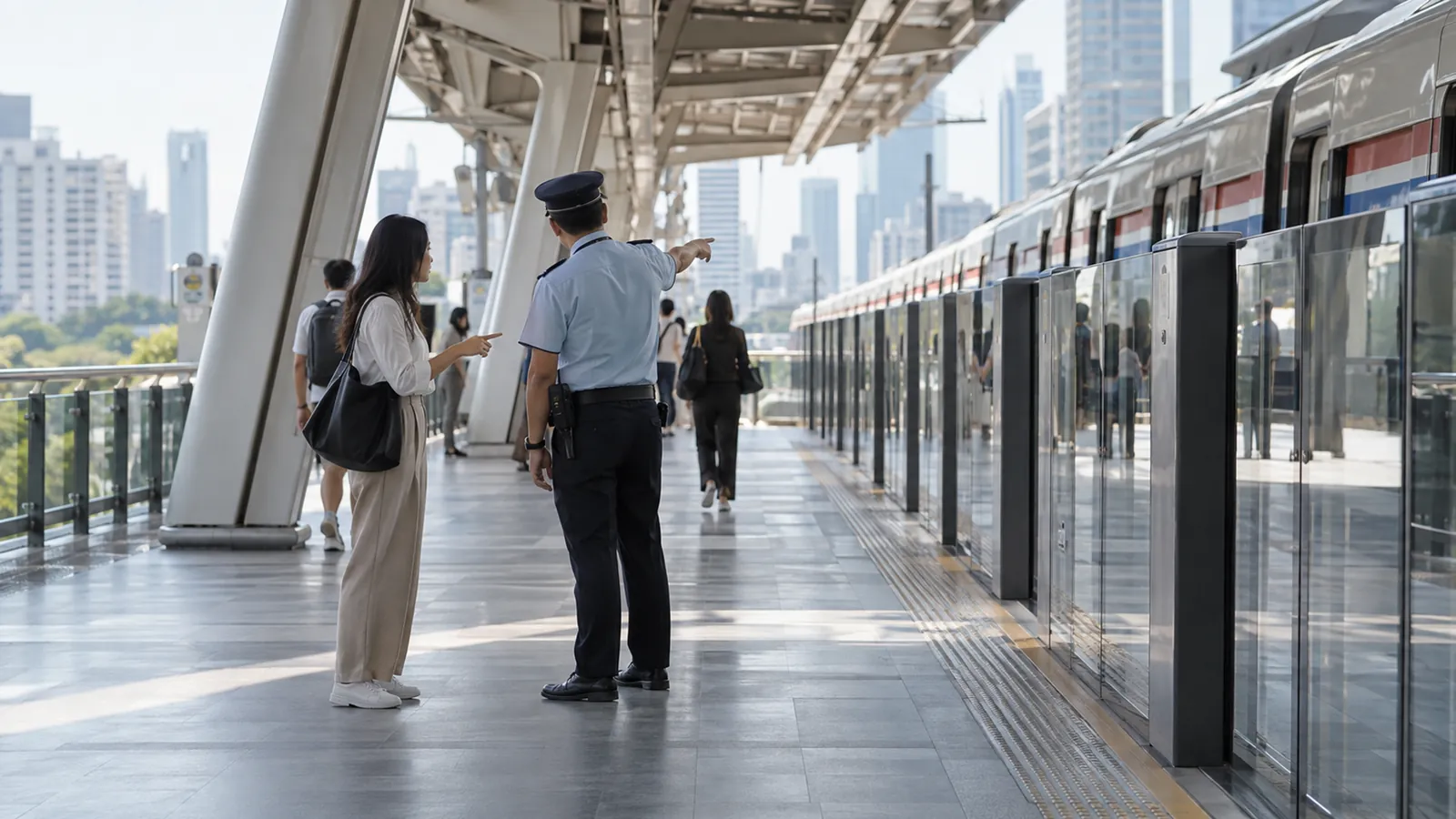
Bangkok’s transit operators have staff, rules and penalties. There is a person on the platform whose job includes this.
And it is more specific than “staff and rules”. The Bangkok Metropolitan Administration’s announcement governing conduct on the system, published by the operator and dated 29 November 1999, prohibits making loud noise or a commotion without reasonable cause, quarrelling, or otherwise disturbing the peace within the system — a fine of up to ฿500. It separately prohibits bullying, threatening, harassing or any act causing another person to be startled, frightened, ashamed or annoyed.
The penalty for that second one is not what this article previously printed, and the difference is the whole point of the piece. The wording tracks section 397 of the Criminal Code, which a 1999 city announcement could only cross-refer to — a municipal announcement cannot impose imprisonment. Section 397 was rewritten and its fines raised, and it now has two paragraphs. Bullying, oppressing, harassing or causing another person shame or annoyance carries a fine of up to ฿5,000. But where the same act is done in a public place or in public view, it carries up to one month’s imprisonment, a fine of up to ฿10,000, or both.
Read that again with the article’s subject in mind. The law does not merely cover what happened on that train. It treats being in public as the aggravating factor — the thing that takes the offence from a ฿5,000 fine to a custodial maximum. The statute already agrees with this article’s argument: a confrontation in front of other people is a different act from the same words in private. It also bans eating and drinking of any kind, alcoholic or not, in trains and inside the paid area. Police officers, city inspection officers and other assigned BMA officials are named in it as the people who keep order.
So there is a written rule against being loud, a heavier written rule against making somebody feel ashamed for objecting, and a person whose job is to enforce both. The rules are twenty-seven years old and precise.
Almost nobody uses them in the moment, and the reason is not ignorance.
Finding staff costs you the train. Explaining costs you several minutes. The people involved get off. The phone costs nothing and takes two seconds.
But the conclusion I originally drew from that — that the formal mechanism loses on speed — is not what happened here. It lost in the carriage and won the next day, at a police station, which is a different and less gloomy finding. What is slow is not the mechanism. It is being inside a moving train with it.
Article 123 Nobody brought a ticket machine found that Thailand is genuinely excellent at attaching enforcement mechanisms inside buildings — numbered tickets, marked queues, staff on platforms. The gap here is narrower than I said: not an absent mechanism, but one that cannot be reached in the ninety seconds between two stations.
Practically
If you are visiting: the expectation on Bangkok transit is quiet. Not silent, but conversation at a level that does not carry down the carriage. Eating and drinking are prohibited on the systems. The absence of anybody telling you off is not evidence that you are fine, which is the single most useful sentence in this article for a visitor.
If somebody does ask you to be quieter, they have paid a real social cost to do it. Article 49 Kreng jai: the one rule underneath all the others explains why. The correct response is to be quieter.
If you are the one being disturbed: staff exist, the conduct rules are written down, and the route works. In this case it produced charges and fines the day after a complaint was laid. It is slower than filming inside the carriage and considerably faster than most people assume once you are off the train.
And if you do film — think about what happens after you post it. You are not choosing whether to object. You are choosing between an objection that ends in the carriage and one that keeps running afterwards — and, as this case showed, one that may become the thing you have to give up to conclude the matter.
Common misconceptions
“Thais are too polite to say anything.” Somebody did say something in this case, out loud, immediately. What article 49 Kreng jai: the one rule underneath all the others describes is a cost, not an incapacity.
“Filming is a passive-aggressive Thai thing.” It is a rational response to a mechanism where direct objection is expensive and ineffective, and it is not remotely confined to Thailand.
“The reaction was xenophobic.” The Thai commentary consensus framed it as public-space manners. Nationality is why the clip travelled.
“This shows tourists behave badly.” It shows one incident. The clips that circulate are selected for being unusual, which is what makes them circulate.
“Nobody can do anything on the BTS.” The BMA’s 1999 conduct announcement bans loud noise and commotion (up to ฿500) and, separately, making another person feel startled, frightened, ashamed or annoyed — which under Criminal Code s.397 is a fine of up to ฿5,000, rising to up to a month’s imprisonment or ฿10,000 or both when done in public, as it is on a train. Police and city officials are named as enforcers.
“Nothing came of it except a viral clip.” A complaint was laid the next day, five people were charged with insulting another in public and fined ฿1,000 each, one further charge carried ฿2,000, and the matter was settled on terms that included removing the footage.
Common questions
- What happened on the BTS in July 2026?
- A Thai passenger asked a group of visiting teenagers on the Silom line to lower their voices, was argued with and abused, and filmed the exchange. The clip circulated widely and an Italian study-programme operator apologised publicly.
- Why do Thai people film rather than confront?
- Direct correction of a stranger carries a social cost that falls on the person objecting. Filming transfers the objection to a distributed audience and imposes no immediate cost.
- Was the reaction about nationality?
- Thai commentary framed the issue as manners in shared public space. The nationality is largely why the clip travelled internationally.
- What are the rules on Bangkok transit?
- Quiet conversation is expected, and eating and drinking are prohibited. Operators have staff and penalties for disruptive behaviour.
- What should I do if someone is being disruptive?
- Staff exist and will act. It is slower than filming and it ends with the problem addressed rather than with a video.
- Do most tourists behave badly on the BTS?
- No. Incidents circulate precisely because they are unusual, which makes a social feed a poor guide to how people generally behave.