Twenty baht was never the price
Bangkok charges ฿60 a month to collect household waste, ฿20 if you register as separating it. On the city's own figures, fees cover about 7% of the cost.
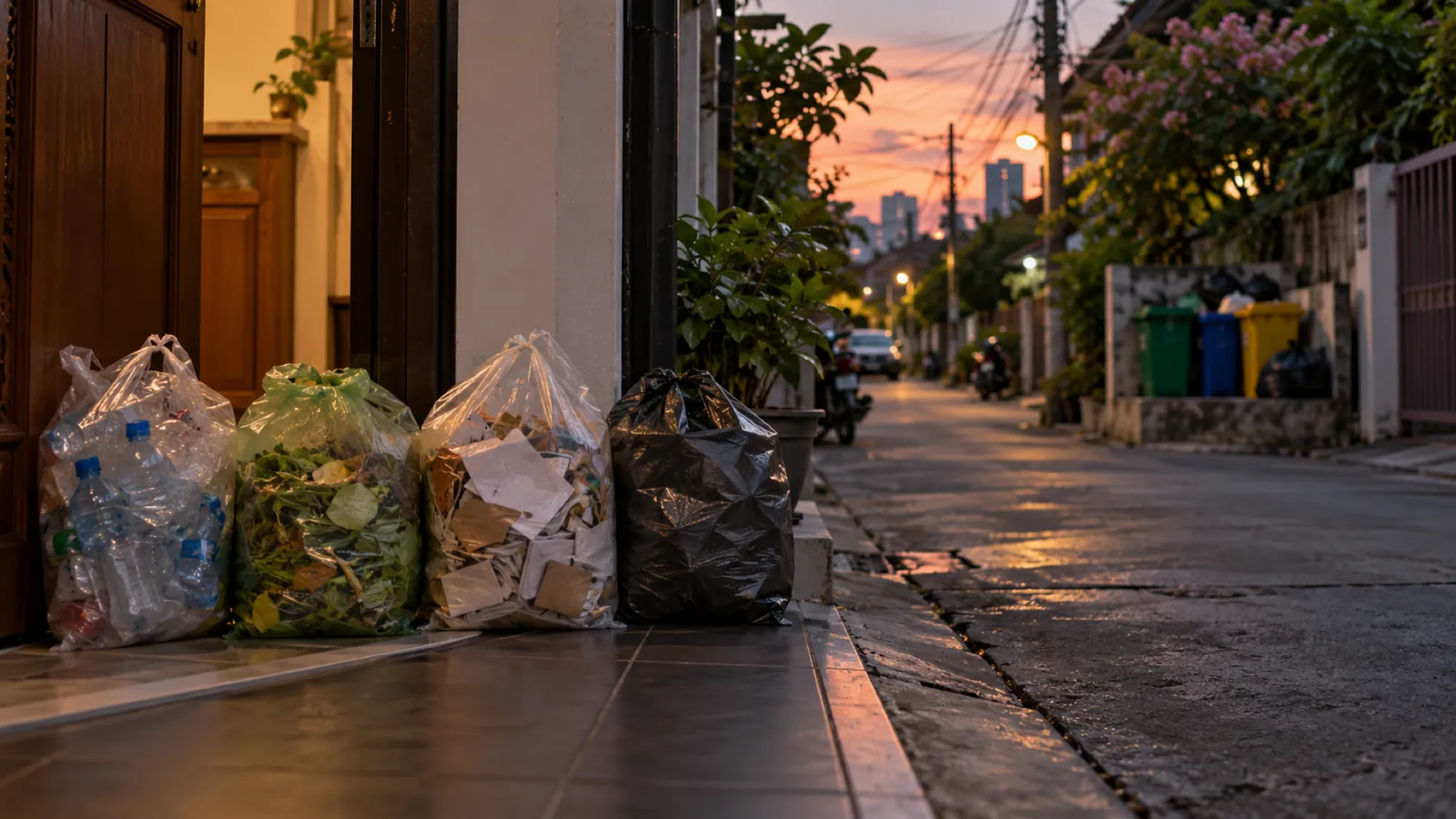
Since October 2025, Bangkok has charged a household ฿60 a month to collect its rubbish — unless it registers as separating that rubbish, in which case the charge is ฿20.
The ordinance behind it — the Bangkok Metropolitan Administration ordinance on service fees for managing sewage and refuse under the public health law, B.E. 2568 (2025) — was approved by the Bangkok Metropolitan Council on 29 January 2025, published in the Royal Gazette on 31 March 2025, and took effect 180 days later, on 28 September 2025. The new rates have been charged from October 2025.
The household rate breaks in two. ฿60 is ฿30 to collect and ฿30 to dispose of. ฿20 is ฿10 and ฿10.
But the household band is only one of three, and the other two are the interesting part.
| What you produce | What you pay |
|---|---|
| Up to 20 litres a day (or 4kg) — a normal home | ฿60 a month, or ฿20 if registered as separating |
| 20 litres to 1 cubic metre a day (4–200kg) | ฿120 per 20 litres, split ฿60 collection and ฿60 disposal |
| More than 1 cubic metre a day (over 200kg) | ฿8,000 per cubic metre, split ฿3,250 collection and ฿4,750 disposal |
Look at what changes between the rows. The household pays a flat monthly sum that does not move with how much it throws away. Everyone above it pays by volume. For the second and third bands the BMA’s own explanation of the incentive is simply that separating reduces the volume presented and therefore reduces the bill — no registration, no declaration, no photograph.
So Bangkok did not choose between a price and a nudge. It wrote both into one ordinance, and the dividing line is whether the quantity can be seen.
The city had already done this arithmetic, and published it
An earlier version of this article said nobody had worked out what the fee covers. That was wrong, and the correction is worth making in full, because the city’s numbers are better than the ones that were circulating.
Speaking at the On Nut disposal plant in February 2025, the BMA’s environment officials put the city’s waste-management cost at ฿7,630 million a year against fee income of ฿540 million a year — which they gave as 7.21%. Ten days later, at a briefing preparing all fifty district offices for the new rates, a deputy permanent secretary gave the same shape in rounder terms: cost over ฿7,000 million, fees about ฿500 million, 7%. An older BMA pairing that still circulates — ฿6,985 million against ฿496 million — comes to 7.1%.
Three statements, one answer: the fee covers about a fourteenth of what the service costs.
⚠️ The two headline figures as given do not quite divide. ฿540 million against ฿7,630 million is 7.1%, not the 7.21% quoted. The gap is a tenth of a percentage point and changes nothing, but this article does not smooth over arithmetic it cannot reproduce.
A figure of around ฿10 billion a year has been widely repeated in Thai and English coverage, and an earlier draft of this article used it. It is roughly a third too high, and it is not what the city says. The likely origin is visible in the budget: Bangkok’s whole natural-resources-and-environment sector — waste, wastewater, pollution control and parks together — comes to ฿10,635 million for the 2026 financial year. That is a real number about something else.
The fee is not a price, and the city does not pretend it is
Take the arithmetic forward with the city’s own denominator.
Bangkok had 3,197,865 registered houses at the end of 2022, on the BMA’s own published series, growing at roughly 1.6% a year. Charge every one of them the full ฿60 and you raise about ฿2,302 million a year — 30% of ฿7,630 million. Charge every one of them ฿20 and you raise about ฿767 million — 10%.
Even universal application at the penalty rate leaves seven-tenths of the cost on general revenue.
So tripling the headline rate is not a revenue measure, and the clearest evidence for that is the city’s own budget. In the annual expenditure ordinance for the 2026 financial year — the first full year under the new rates — the BMA’s estimate for waste collection fee income is ฿560 million, down from ฿800 million the year before. Its estimate for general waste disposal fee income is ฿580 million, down from ฿800 million. Together: ฿1,140 million against ฿1,600 million, a cut of 29%.
A city that had just tripled a charge budgeted for less money from it. Some of that is a realism correction — the ฿800 million estimates sat a long way above the ฿540 million actually collected — but no revenue-raising measure is written up that way. The city expected the ฿20 band to be where people went, and it wrote the loss into its accounts.
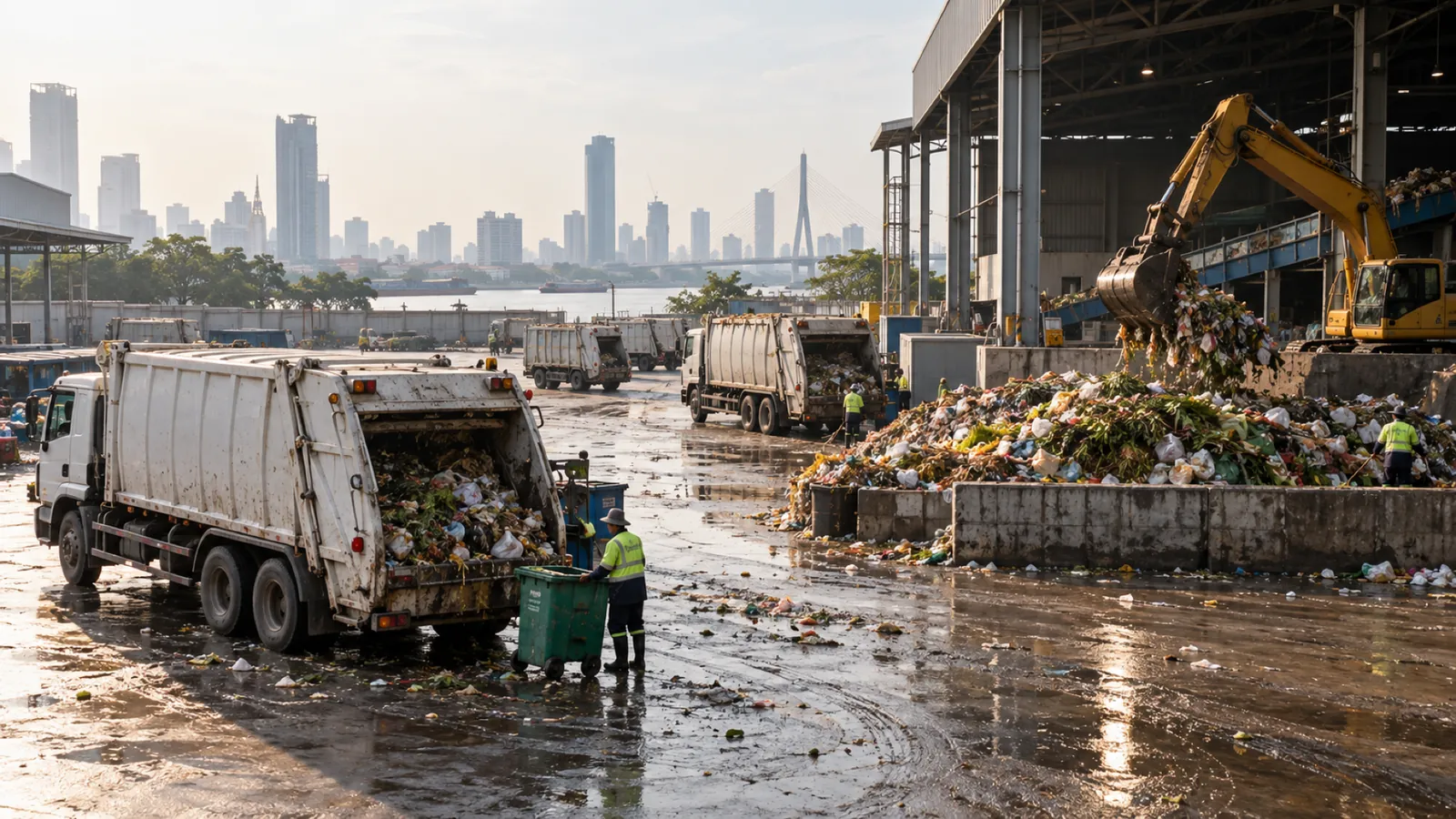
And the ฿20 is not a discount
This is the part the English coverage has consistently got backwards.
฿20 a month is what a Bangkok household was already paying. The BMA’s own wording, in a district office’s notice to residents, is that a home that registers and separates keeps the fee at the rate it used to pay. The change is not that separators get a reduction. The change is that everyone else goes to ฿60.
That is a materially different instrument. A discount offers you something you did not have. This threatens the removal of something you did — and behavioural economics has been clear for fifty years about which of those moves people. Whether or not the BMA framed it that way deliberately, the framing is in the ordinance’s structure: there is no new benefit anywhere in it.
The state cannot see inside your bin
So it has asked you to photograph it.
Where the quantity is visible — a skip, a lorry load, a cubic metre — the ordinance simply prices it. Where it is not, the city has built a declaration and an audit around it, and the published design is more elaborate than the earlier draft of this article credited:
- You register through the BKK Waste Pay app, or at a district office if you have no smartphone, using your eleven-digit House ID, your name, a phone number, and photographs of four separated streams — food waste, recyclables, general waste, and hazardous waste if you have any.
- The system randomly checks separation every three months.
- You must re-submit the four photographs every six months to keep the reduced rate. Households approved from the first month, October 2025, were prompted to do so from 1 April 2026.
- The BMA has said it is bringing in image recognition to check the photographs and stop the same picture being used twice.
- The entitlement can be suspended, by written notice, and there is an appeal route against that notice.
- Since March 2026 there is an explicit opt-out — a “do not wish to separate” setting that stops the app asking for photographs and issues a bill at ฿60.
That is a serious design, and this article is not sneering at it. It is that the instrument has changed category. This is no longer a charge; it is a declaration with audit — which is how income tax works, and how a great many things work perfectly well. Sampling is a legitimate technology.
But a photograph establishes that separated waste existed at the moment the photograph was taken. It does not establish that the household separates every week, which is the behaviour the ฿40 is paying for. The observable artefact and the governed habit are different things, and adding an image model to the check makes the artefact harder to forge without making it any closer to the habit.
Article 162 The fine has a ceiling and the damage does not found the anti-corruption commission asking for weigh-in-motion sensors because a truck’s weight is invisible until it stops at a weighbridge. Article 165 The rule is about the road found a building code built entirely from tape-measure quantities because those need no judgement. Article 161 None of them is about the building found a venue test sorting by observable conduct while the danger was structural.
Here the state has gone one step further and built an app to manufacture the observation — an unobservable habit converted into a photograph, because a photograph can be filed.
The thing worth watching is therefore not the fee. It is how many of the three-monthly checks actually happen, and how many suspension notices follow. The cadence is published. The volume is not, and that is the number this article could not obtain.
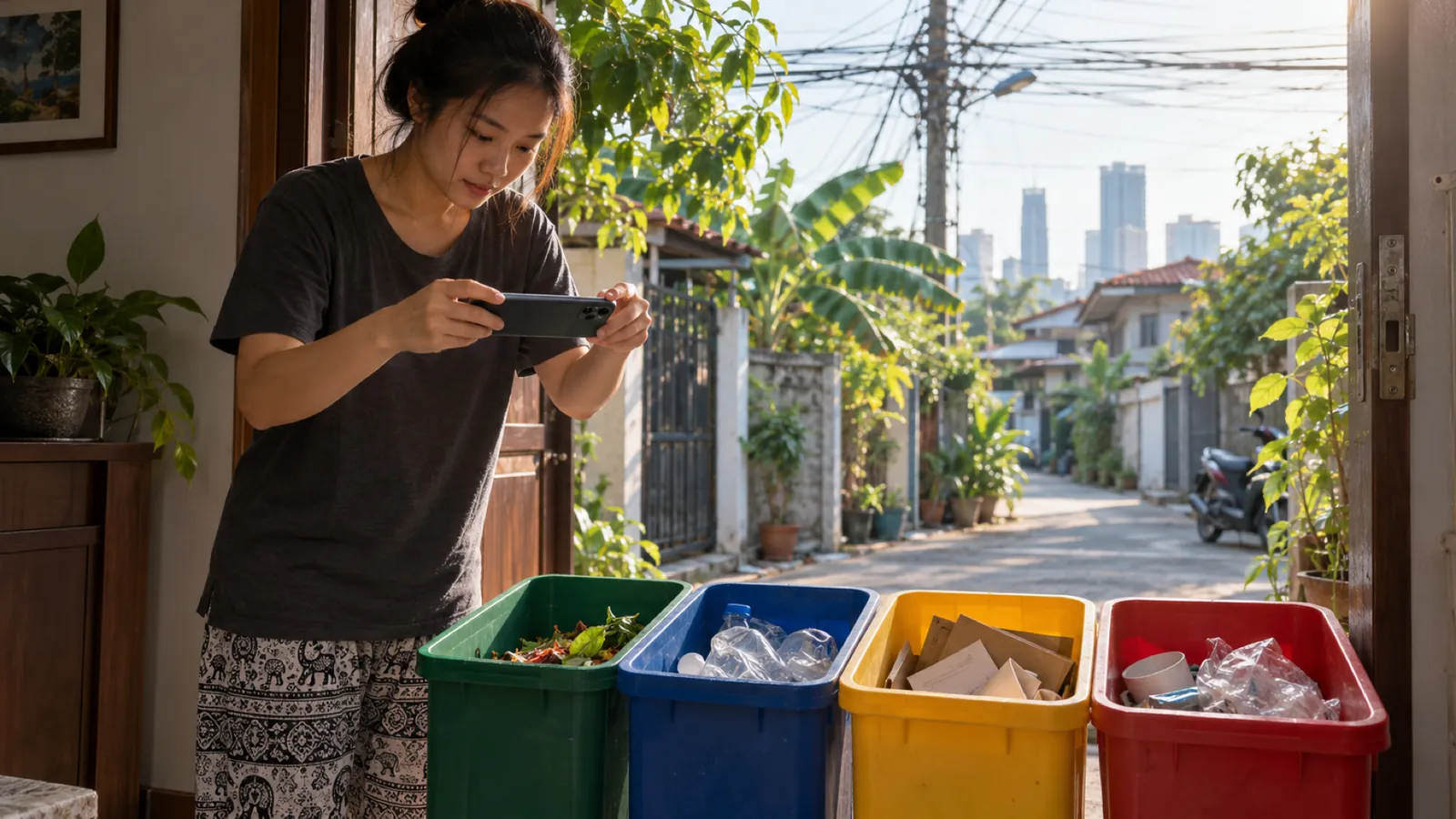
Registered is not approved
As at 26 March 2026, 1,196,958 households had registered for บ้านนี้ไม่เทรวม — “this house doesn’t pour it all together”. 823,525 had been granted the reduced rate.
The gap is 373,433 households — 31% of registrations — and an earlier version of this article, along with most coverage, quoted the larger number as though it were the smaller one.
The registrations split into 412,545 individual — houses, and flats or condominiums without a juristic person — and 4,937 group registrations covering 784,413 dwellings, which is how estates and condominium buildings with a management company enter. Group registration opened on 1 August 2025.
Against roughly 3.2 million registered houses, 1.2 million registrations is a little over a third of the city and 823,525 approvals is about a quarter. ⚠️ Registered houses is not the same population as chargeable households — the register includes empty properties and counts condominium units in ways the fee does not always follow — so treat this as the right order of magnitude rather than a rate.
A quarter of Bangkok on the lower rate after six months is not a failure and it is not a triumph. It is the honest number, and no English-language account this article could find has carried it.
What the money goes on, and why the budget cannot tell you
Here is what the published accounts do say. Bangkok’s expenditure ordinance for the 2026 financial year totals ฿91,916,771,160. Within it:
- The Environment Department gets ฿4,383,877,793, of which its waste-and-sewage programme is ฿2,510,803,957 — the largest single line being ฿1,223,391,540 to dispose of general and construction waste at the three centres.
- The fifty district offices get ฿24,409,929,957 for service provision. The waste and cleaning lines you can identify inside that come to about ฿1,090 million: ฿714,605,242 for running the cleaning divisions, ฿323,360,680 for refuse collection and sewage transport, ฿47,899,970 for street sweeping.
That is roughly ฿3.6 billion of the ฿7,630 million the city says waste costs it. The rest is not findable.
The reason is a single line: ฿9,592,198,290 of district personnel spending, pooled across every function a district office performs and not broken out by any of them. Bangkok’s refuse collectors and street sweepers are in there. So are its clerks, its engineers and its registrars.
The city can tell you what waste costs. Its published budget cannot show you. That is the same problem as the photograph, one level up: the thing that matters is real, and the record that exists is of something adjacent to it.
Whatever the true split, the direction is not in doubt. ฿7,630 million across roughly 3.2 million registered houses is about ฿2,400 a house a year, or ฿200 a month, and the fee is twenty. The difference comes from general revenue, which is to say from everybody, including people who produce almost no waste.
That is article 89’s structure in a mild and mostly benign form — a service funded universally and charged categorically — and it is the reason nobody has ever seriously proposed charging the real cost. A household bill of two hundred baht a month for rubbish would be politically impossible, and probably regressive.
So the ฿20 is best understood as a token of participation rather than a payment, and the ฿60 as a penalty attached to a declaration. Neither has ever been a price.

And the question about the truck
Tom’s commission had three parts. Two are now answered from the city’s own documents. The third has a partial answer that is itself revealing.
Bangkok publishes exactly one collection timetable, and it is for sofas. The monthly นัดทิ้ง นัดเก็บขยะชิ้นใหญ่ service — bulky waste, free, by district, weekend mornings from 09:00 to 12:00 with the points listed in advance — is scheduled, advertised and easy to find. Food waste, under the separation scheme, is collected on rounds each district office sets for itself. The routine household round has no published timetable at all.
Which is the pattern again. What gets a schedule is what needs an appointment: a single large object, one household, one time. The daily round is a continuous flow across a network, and nothing about it is individually observable, so nothing about it is individually published.
What can be offered on top of that is a structural inference, clearly labelled as one.
Article 164 Nobody built the connections established that more than 45% of Bangkok’s road length is dead-end soi — 18,355 kilometres of street that connects to the network at one end only.
A collection truck faces the same constraint as a fire engine. It has to get in, and it has to get out. In a soi with one end, that means reversing the length of it, or not entering at all.
Which would explain something every Bangkok resident has observed without being told: that bins cluster at the mouths of sois rather than outside individual houses, and that the truck’s arrival is unpredictable because a route through a fishbone network is far harder to schedule than a route through a grid.
That is a hypothesis with a good pedigree and no evidence behind it in this article. The BMA holds route data. Somebody should ask.
Common misconceptions
“The fee pays for collection.” On the city’s own figures it covers about 7%. The rest comes from general revenue.
“They tripled the fee to raise money.” In the budget for the first full year at the higher rate, the BMA cut its own estimate of waste fee income by 29%.
“It’s pay-as-you-throw.” For households, no — the fee is flat and does not vary with how much you discard. For anyone producing more than 20 litres a day, yes — those bands are priced per 20 litres and per cubic metre.
“฿20 is a discount for separating.” ฿20 is the rate Bangkok households were already paying. Separating keeps it; not separating loses it.
“Nearly 1.2 million households are paying ฿20.” 1,196,958 had registered by 26 March 2026. 823,525 had been approved.
“The city checks whether you separate.” It takes photographs you upload, re-checks every three months, requires the photographs again every six, and has said it will use image recognition to catch reuse. A photograph still establishes a moment, not a habit.
Common questions
- How much is Bangkok's rubbish fee?
- ฿60 a month for a household, reduced to ฿20 if it registers as separating its waste. Larger producers pay by volume: ฿120 per 20 litres a day, or ฿8,000 per cubic metre.
- When did it change?
- The ordinance was gazetted on 31 March 2025, took effect on 28 September 2025, and charging began in October 2025.
- Is ฿20 a discount?
- No. ฿20 is the rate Bangkok households were already paying. Registering and separating keeps it; not doing so raises the bill to ฿60.
- How do I get the lower rate?
- Register through the BKK Waste Pay app, its website, a district office or a fee collector, under the บ้านนี้ไม่เทรวม scheme, with your eleven-digit House ID and photographs of four separated waste streams.
- How many households have registered?
- 1,196,958 as at 26 March 2026, of which 823,525 had been approved for the reduced rate.
- Does the fee cover the cost of collection?
- No. The BMA's own figures put the cost at ฿7,630 million a year against ฿540 million in fees — about 7%.
- How does the city verify separation?
- Photographs of four waste streams uploaded at registration, random checks every three months, and the photographs again every six months. The BMA has said it will use image recognition to stop the same picture being submitted twice.
- What time does the truck come?
- There is no published timetable for the routine household round. The only scheduled collection Bangkok advertises is the monthly bulky-waste appointment service.